


He became pharaoh at nine years old. He died at nineteen. Yet in those ten short years, King Tutankhamun accomplished what many pharaohs couldn’t achieve in decades: he saved Egyptian religion from collapse.
More than 3,000 years after his death, King Tutankhamun still fascinates the world. Though he ruled for less than a decade, the King Tut accomplishments forever changed Egypt’s destiny. Crowned as a child, the “boy king” brought back the worship of Egypt’s ancient gods, rebuilt abandoned temples, and healed a nation divided by his father’s religious revolution.
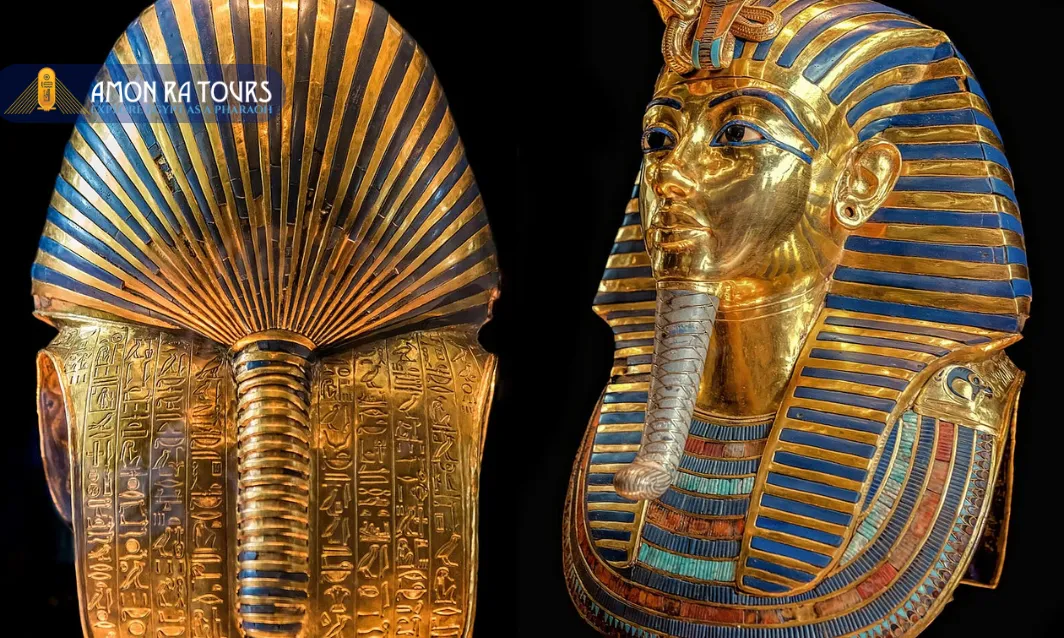
Today, Tutankhamun’s golden mask and treasures, displayed at the Grand Egyptian Museum, continue to inspire millions. But his true legacy lies not in gold, but in what he restored: Egypt’s 3,000-year-old faith, art, and identity.
Discover what the boy king really achieved, why his reign was a turning point, and where you can see his treasures today.
Quick Answer: King Tut Accomplishments
Reign: 1332-1323 BCE (approximately 10 years)
Age at death: ~19 years old
Dynasty: 18th Dynasty, New Kingdom
His 8 Major Accomplishments:
- Restored traditional Egyptian religion after 17 years of monotheistic Aten worship
- Reopened temples across Egypt from Elephantine to the Delta
- Reinstated the priesthood with salaries and temple lands
- Moved the capital from Amarna back to Thebes (religious) and Memphis (administrative)
- Rebuilt damaged temples at Karnak, Luxor, Memphis, and throughout Egypt
- Revived Egypt’s economy through temple restoration and trade route reopening
- Maintained diplomatic relations with neighboring kingdoms during a vulnerable period
- Left the most intact royal tomb ever discovered, preserving knowledge of New Kingdom burial practices
Why he’s famous today: Not his accomplishments, but his nearly intact tomb discovered in 1922, the only royal burial found with 5,000+ treasures still inside, including his iconic golden mask.
Where to see his legacy:
- Tomb: Valley of the Kings, Luxor (KV62)
- Treasures: Grand Egyptian Museum, Giza (complete collection)
- Mummy: Valley of the Kings (displayed in climate-controlled case)
Birth & Family: The Inbreeding That Shaped His Life
Born Into Royal Turmoil (c. 1341 BCE)
Tutankhamun was born around 1341 BC during the 18th dynasty of ancient Egypt. He was the son of Pharaoh Akhenaten, the ruler who introduced a new monotheistic religion centered around the sun god Aten.
A Family Tree of King Tutankhamen
King Tutankhamun’s family tree reveals the consequences of royal inbreeding practiced to “preserve divine bloodline purity”:
Father: Akhenaten (the “heretic pharaoh”)
Mother: The “Younger Lady” mummy (identified through DNA as Akhenaten’s full sister)
Wife: Ankhesenamun (his half-sister, daughter of Akhenaten and Nefertiti)
Meaning of his name
The name Tutankhamun carries deep symbolic meaning in ancient Egyptian culture. It translates to “the living image of Amun,” referring to the powerful god Amun, one of the main deities of ancient Egypt. The name reflects the king’s role in restoring the worship of Amun after his father had replaced the old gods with Aten.
From Tutankhaten to Tutankhamun
Before becoming the famous boy king we know today, Tutankhamun was originally named Tutankhaten, meaning “the living image of Aten.” This name reflected his father, Akhenaten’s, radical religious reforms, which centered on worshiping the sun god Aten alone. However, after Akhenaten’s death, Egypt began returning to its traditional beliefs.
As part of this major shift, the young pharaoh changed his name to Tutankhamun, “the living image of Amun”, to honor the old gods and restore their temples. This name change symbolized more than just religion; it marked Egypt’s return to balance, tradition, and political stability under the boy king’s reign.
King Tut’s 8 Major Accomplishments
The King Tut accomplishments left a lasting mark on ancient Egypt, even though his reign was short. His leadership helped restore balance to a kingdom that had faced years of religious and political chaos. Among his major accomplishments:
1. Restored Traditional Egyptian Religion
The most important of all King Tut’s accomplishments: Reversing 17 years of enforced monotheism.
What he did:
- Declared the ban on traditional gods null and void
- Announced Amun’s restoration as King of Gods
- Reopened worship of the full Egyptian pantheon (Amun, Ra, Osiris, Isis, Ptah, Hathor, Anubis, etc.)
- Changed his name from Tutankhaten to Tutankhamun as public proof
Evidence: The Restoration Stela (large stone inscription erected at Karnak Temple around 1327 BCE) documents this reform in detail.
Key passage from the Restoration Stela:
“The temples of the gods and goddesses, from Elephantine [Aswan] to the marshes of the Delta, had fallen into ruin. Their shrines had become desolate, overgrown with weeds… If one prayed to a god to seek counsel from him, he would never come at all.”
The stela describes Egypt’s spiritual desolation under Akhenaten, then announces Tutankhamun’s solution:
“His Majesty [Tutankhamun] made monuments for the gods, fashioning their cult statues of genuine fine gold… He filled their workshops with male and female slaves… All the taxes of the palace were assigned to them.”
Impact: This single reform reunited Egypt spiritually, politically, and economically. Without it, the kingdom might have fractured into competing regions.
2. Reopened and Rebuilt Temples Across Egypt
Physical evidence of restoration: Temple inscriptions, partially completed construction projects, and the Restoration Stela’s specific claims.
Major temple restoration projects:
Karnak Temple (Thebes/Luxor)
- Repaired Amun’s main sanctuary
- Added new statues of Amun (using gold from the royal treasury)
- Commissioned new reliefs showing Tutankhamun making offerings
- Restored processional routes for religious festivals
Luxor Temple
- Continued construction started by Amenhotep III
- Added colonnade decorations
- Restored sphinx-lined avenue to Karnak
Memphis (Administrative Capital)
- Rebuilt Ptah’s temple complex
- Restored workshops for craftsmen
- Reopened trade facilities
Heliopolis
- Reconstructed Ra-Horakhty’s temple
- Restored solar cult rituals
Hermopolis
- Reopened Thoth’s temple (god of wisdom, writing)
Scale documented in Restoration Stela:
“He made monuments for the gods in [statues of] genuine fine gold from the highlands, building their sanctuaries anew as monuments for the ages of eternity, endowed with possessions forever, setting for them divine offerings as a regular daily observance.”
Economic impact of rebuilding:
- Thousands of jobs created: Stone carvers, sculptors, painters, craftsmen
- Gold and precious stone trade revived: Materials sourced from Nubia, Sinai, and trade partners
- Temple economies reactivated: Agriculture, workshops, storage facilities
Evidence in Tutankhamun’s tomb: The 5,000+ gold and precious stone objects found in his burial prove Egypt’s economy had recovered sufficiently to produce luxury goods again. Workshops closed under Akhenaten were clearly operational by Tutankhamun’s death.
3. Reinstated the Priesthood
The problem Tutankhamun inherited: Akhenaten had dismissed traditional priesthoods, leaving tens of thousands unemployed and temples unmanaged.
Tutankhamun’s solution:
Restored priestly positions:
- High Priests of Amun (most powerful)
- Priests of Ra, Osiris, Ptah, and regional deities
- Temple administrators and scribes
- Ritual performers and chanters
Provided financial support:
The Restoration Stela specifies:
“He filled their workshops with male and female slaves from the captives of His Majesty… All the temple property was doubled, tripled, and quadrupled in silver, gold, lapis lazuli, turquoise, and every precious stone.”
Returned temple lands:
- Agricultural estates confiscated by Akhenaten were returned
- Temples could again generate income from harvests
- Grain storage for famine relief resumed
Political significance:
Restoring the priesthood wasn’t just religious; it was political stabilization. The Amun priesthood at Thebes was Egypt’s most powerful institution after the pharaoh. Keeping them allied was essential for political survival.
4. Moved the Capital Back to Thebes & Memphis
Akhenaten’s capital: Akhetaten (modern Amarna), a brand-new city built exclusively for Aten worship, isolated from traditional power centers.
Tutankhamun’s strategic move:
Religious capital: Thebes (Luxor)
- Traditional religious center for 500+ years
- Home of Karnak Temple (Amun’s main sanctuary)
- Symbolized a return to orthodox religion
- Pleased the powerful Amun priesthood
Administrative capital: Memphis
- Strategic location near the Delta and trade routes
- Historical administrative center
- Practical for governing Lower Egypt
- Balanced power between Upper and Lower Egypt
What happened to Amarna: Abandoned. Akhenaten’s city was gradually dismantled, its stones reused for other projects. The Aten temples were demolished. Within a generation, Akhetaten became a ghost town, physical proof that Atenism had ended.
Impact: This move signaled to Egyptians, foreign allies, and potential rebels that the Amarna period was over. Stability had returned.
5. Revived Egypt’s Economy Through Restoration
The economic crisis Tutankhamun inherited:
- Temple closures = mass unemployment
- Trade disruption (partners didn’t trust unstable Egypt)
- Agricultural disruption (temple lands neglected)
- Luxury goods production halted (workshops closed)
Tutankhamun’s economic revival:
Job Creation Through Temple Restoration
Rebuilding temples employed:
- Stone cutters and quarry workers (extracting limestone, granite, sandstone)
- Sculptors and carvers (creating statues, reliefs, hieroglyphs)
- Painters (decorating walls with traditional scenes)
- Gold workers and jewelers (crafting divine statues and ritual objects)
- Carpenters (building doors, shrine structures, furniture)
- Linen weavers (producing cloth for priestly garments and offerings)
Evidence: The quality and quantity of objects in Tutankhamun’s tomb prove these workshops were fully operational by his death.
Trade Route Reopening
- Byblos (Lebanon): Cedar wood imports resumed (needed for boat-building, temple doors, luxury furniture)
- Nubia (Sudan): Gold mining operations restored under temple supervision (Nubia = Egypt’s primary gold source)
- Sinai Peninsula: Turquoise mining expeditions reopened (turquoise used in jewelry, temple inlays)
- Punt (Somalia/Eritrea region): Incense trade reestablished (myrrh and frankincense essential for temple rituals)
- Syria-Palestine region: Diplomatic stability allowed trade in lapis lazuli, oils, and manufactured goods
Agricultural Recovery
Returning temple lands to the priesthoods meant:
- Organized agricultural production resumed
- Grain surplus stored for bad harvest years
- Temple offerings (bread, beer, meat) could be made daily
- Economic stability for temple-dependent communities
The proof: Tutankhamun’s tomb contained:
- Gold (from Nubia)
- Lapis lazuli (from Afghanistan via Syrian traders)
- Turquoise (from Sinai)
- Cedar wood (from Lebanon)
- Fine linen (from Egyptian workshops)
- Exotic oils and unguents (from Punt)
This diversity of materials proves international trade networks were functioning again.
6. Maintained Diplomatic Relations During Crisis
The diplomatic challenge: Foreign kingdoms viewed Akhenaten-era Egypt as unstable and unreliable. Letters from the Amarna diplomatic archive show:
- Allies complained Egypt ignored their requests for help
- Trade partnerships were strained
- Military alliances weakened
Tutankhamun’s diplomatic achievements:
Hittite Relations
Though tensions existed (Hittites expanding into Syria), open warfare was avoided. After Tutankhamun’s death, his widow Ankhesenamun even wrote to the Hittite king seeking a prince to marry, suggesting diplomatic channels remained open.
Nubian Stability
Inscriptions and tomb paintings show that Egyptian control of Nubia was maintained. Border forts remained garrisoned, gold shipments continued, and no major rebellions occurred.
Syrian Buffer Zones
While Egypt didn’t launch major conquering campaigns, evidence suggests border areas were secured through local alliances and small military operations.
Trade Partner Reassurance
By restoring traditional religion and moving the capital back to established centers, Tutankhamun signaled to foreign partners that Egypt was stable again, encouraging renewed trade relationships.
Why this matters: Egypt, during Tutankhamun’s reign, was vulnerable. A major war or rebellion could have been catastrophic. Maintaining peace allowed the kingdom to focus on internal restoration.
7. Restored Traditional Art and Culture
Akhenaten’s artistic revolution: Under Atenism, Egyptian art changed dramatically:
- Amarna art style: Elongated skulls, exaggerated features, casual poses
- Subject matter: Only Aten (sun disc), Akhenaten, and the royal family
- Traditional gods: Banned from artwork
Tutankhamun’s cultural restoration:
Return to Traditional Artistic Styles
- Gods reappeared: Tomb and temple paintings again showed Amun, Osiris, Anubis, and Isis
- Classical proportions returned: Idealized, balanced human figures (not Amarna’s distortions)
- Afterlife scenes restored: Books of the Dead, underworld journeys, judgment scenes
- Divine pharaoh imagery: King shown with gods, making offerings, receiving blessings
Evidence in Tutankhamun’s tomb:
The tomb’s wall paintings show traditional New Kingdom style, not Amarna art:
- Tutankhamun was embraced by Osiris (god of the afterlife)
- The Opening of the Mouth ceremony (traditional funerary ritual)
- The Pharaoh making offerings to the gods
- Protective deities surrounding the burial chamber
Festival Revival
Traditional religious festivals were restored:
- Opet Festival: Annual procession of Amun’s statue from Karnak to Luxor Temple
- Beautiful Festival of the Valley: Honoring deceased ancestors
- Sed Festival preparations: Jubilee celebration for pharaohs (Tutankhamun died before celebrating his)
Cultural impact: These festivals were social, economic, and religious events that reinforced community bonds and Egyptian identity. Their restoration helped reunify the population.
8. Left the Most Intact Royal Tomb in History
Ironically, Tutankhamun’s greatest contribution to modern knowledge wasn’t something he planned: His nearly intact tomb, discovered in 1922, became a time capsule preserving details of New Kingdom royal burial that would otherwise be lost forever.
Why his tomb survived when others didn’t:
- Small size: Likely not his originally intended tomb (possibly adapted from a noble’s burial)
- Quick burial: His unexpected death at 19 meant hasty preparations
- Location: Built below Ramses VI’s later tomb; debris from that construction buried Tut’s entrance
- Overlooked by ancient looters: Larger, more obvious tombs were robbed instead
What we learned from the tomb:
- Complete burial equipment: From shabti figures to canopic jars—everything needed for the afterlife
- Royal regalia: Crowns, scepters, thrones showing pharaonic authority symbols
- Daily life objects: Games, clothing, food, wine, revealing royal lifestyle
- Mummification practices: Detailed evidence of New Kingdom embalming techniques
- Religious beliefs: Amulets, spells, and protective deities showing afterlife theology
- Artistic excellence: The craftsmanship level achieved by Egyptian artisans
- Economic wealth: The sheer amount of gold, precious stones, and luxury materials
The 5,000+ objects found include:
- Golden mask (11kg solid gold)
- Three nested coffins (innermost solid gold, 110kg)
- Four gilded shrines (protecting the sarcophagus)
- Canopic shrine and jars
- Meteorite-iron dagger
- Golden throne
- 6 chariots (2 war, 4 ceremonial/hunting)
- 130+ walking sticks (he needed them for his clubfoot)
- Jewelry, amulets, rings
- Clothing and sandals
- Furniture (beds, chairs, chests)
- Model boats
- Weapons (bows, arrows, swords, shields)
- Food offerings
- Wine jars
- Two mummified fetuses (his stillborn daughters)
Why Is King Tut So Famous? (Hint: It’s Not His Accomplishments)
The paradox: Tutankhamun was a relatively minor pharaoh who:
- Ruled for only 10 years
- Died young without heirs
- Didn’t build pyramids
- Didn’t conquer new territories
- Didn’t achieve legendary status in his lifetime
Yet today, he’s the most famous pharaoh in the world.
Why? One reason: Howard Carter’s 1922 discovery.
- Didn’t achieve legendary status in his lifetime
The 1922 Discovery: How Carter Found the Tomb
Who Discovered King Tut’s Tomb?
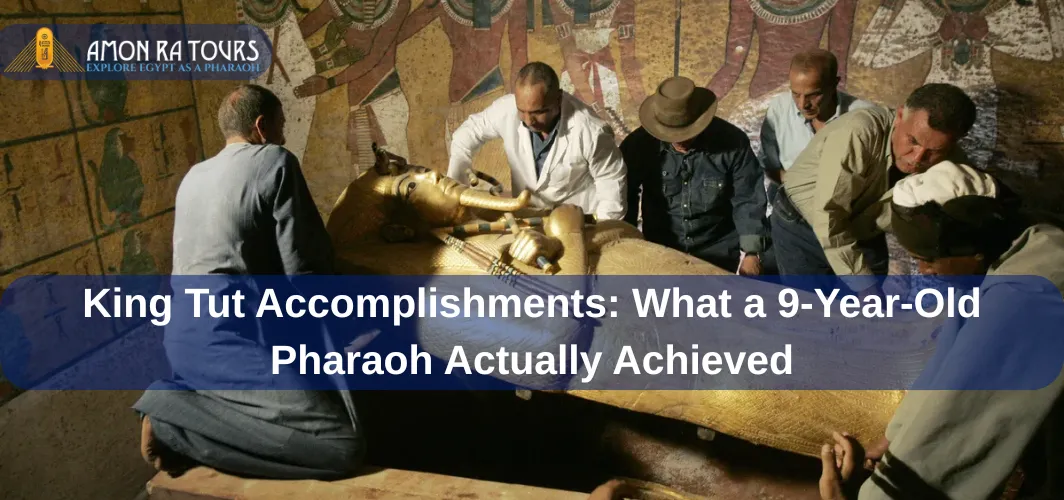
The tomb of the young pharaoh was discovered in 1922 by British archaeologist Howard Carter, after years of dedicated searching in the Valley of the Kings. Carter’s discovery became one of the greatest achievements in the history of archaeology.
Howard Carter’s 5-Year Search
- British archaeologist Howard Carter, funded by Lord Carnarvon, spent five years systematically searching the Valley of the Kings.
- The challenge: By 1922, most archaeologists believed the Valley of the Kings was thoroughly explored. Nothing significant remained to find.
- Carter disagreed. He noticed a triangular area beneath Ramses VI’s tomb that hadn’t been properly excavated, covered by limestone debris from later construction.
November 4, 1922: The First Step
Carter’s workmen uncovered a stone step cut into the bedrock. Then another. And another. Sixteen steps leading down to a sealed doorway.
The doorway bore royal seals: Tutankhamun’s name was visible.
Carter sent an urgent telegram to Lord Carnarvon in England: “At last have made wonderful discovery in Valley; a magnificent tomb with seals intact; re-covered same for your arrival; congratulations.”
November 26, 1922: “Wonderful Things”
With Lord Carnarvon present, Carter made a small hole in the second sealed doorway and peered inside by candlelight.
Carnarvon, standing behind him, asked anxiously: “Can you see anything?”
Carter, barely able to speak, replied: “Yes, wonderful things.”
What Carter saw in that moment:
- Golden couches shaped like animals
- Chariots dismantled and stacked
- Alabaster vases
- Golden shrines
- Statues with eyes that seemed to watch him
- Everywhere, gold
The realization: This was an intact royal tomb, the only one ever found in the Valley of the Kings. Every other royal burial had been thoroughly looted in ancient times.
The 10-Year Excavation
Carter and his team spent 10 years carefully documenting, photographing, and removing over 5,000 objects from the tomb.
The tomb structure:
- Entrance corridor: 16 steps down
- Antechamber: First room, filled with furniture, chariots, boxes
- Annex: Small side room, packed with objects in disorder
- Burial chamber: Contained four gilded shrines, a sarcophagus, and three nested coffins
- Treasury: Held canopic shrine, shabti figures, model boats, ritual objects
What made this discovery unique:
Every other royal tomb had been robbed:
- Ramses II’s tomb: Looted
- Seti I’s tomb: Looted
- Thutmose III’s tomb: Looted
- Hatshepsut’s tomb: Looted
Only Tutankhamun’s survived relatively intact (evidence shows two minor robberies in antiquity, but robbers were caught before taking much).
Why it survived:
- Small, easily overlooked
- Entrance buried under debris from Ramses VI’s later tomb
- Quick, hasty burial (possible confusion about location)
- Located in a less-obvious area of the Valley
Is Tutankhamun’s Tomb Worth Visiting Today?
Short answer: Absolutely yes.
Location: Valley of the Kings (West Bank, Luxor), Tomb KV62
What you’ll experience:
The Tomb Interior
Size: Small compared to other royal tombs (Tutankhamun’s burial was rushed; this may have been a noble’s tomb adapted quickly)
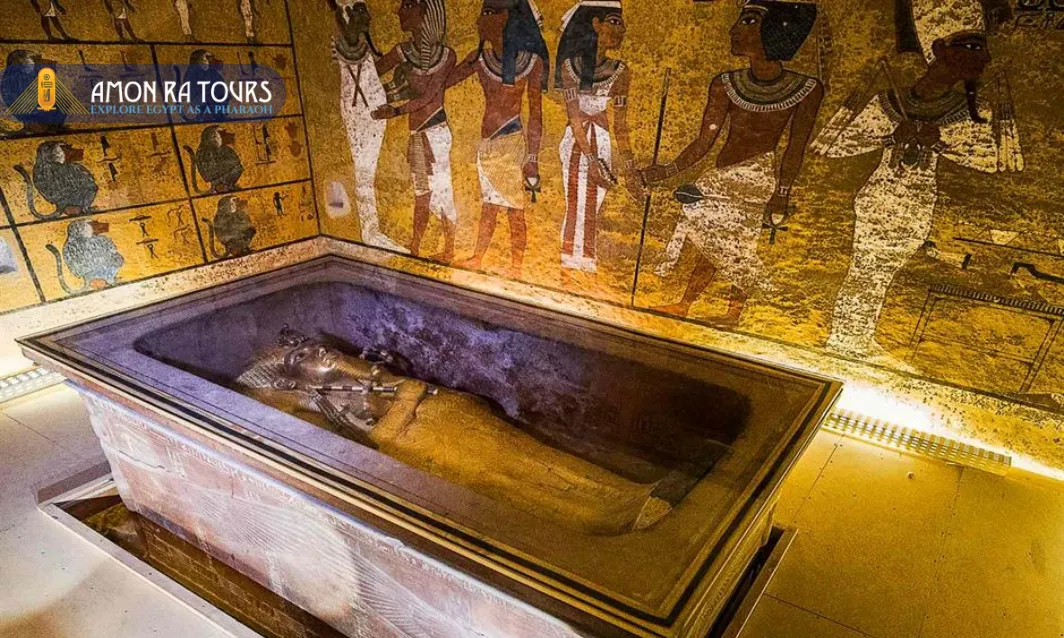
Wall paintings:
- North wall: Opening of the Mouth ceremony (restoring the mummy’s senses)
- East wall: Tutankhamun’s funeral procession, nobles pulling his shrine
- West wall: Baboons representing the 12 hours of night
- South wall: Tutankhamun embraced by Osiris, Anubis, and Hathor
Colors: Still vibrant after 3,300 years, golds, blues, and reds preserved in a sealed environment
The burial chamber:
- Empty sarcophagus (lid open)
- Gilded wooden shrines (replicas, originals in museum)
- Tutankhamun’s mummy is displayed in a climate-controlled glass case
The experience: Standing in the actual room where the boy king was sealed 3,300 years ago is profound. You’re meters from his mummy, in the space Howard Carter entered in 1922, seeing the same wall paintings that surrounded Tutankhamun’s burial.
Visitor Information
Tickets: Separate ticket from general Valley of the Kings pass (tomb considered “special access”)
Best time to visit: Early morning (7-8 AM) before tour groups arrive, or late afternoon (3-4 PM) when crowds thin
Photography: Not allowed inside the tomb (preserves wall paintings from camera flash damage)
Accessibility: Requires descending steep stairs, not wheelchair accessible
How long: 15-20 minutes inside the tomb (small space, limited capacity)
Combine with: Visit 2-3 other Valley of the Kings tombs (Ramses III, Seti I, Thutmose III recommended for contrast, they’re much larger and more elaborate)
Tutankhamun’s Treasures at the Grand Egyptian Museum
The Complete Collection: First Time in History
The Grand Egyptian Museum (GEM) in Giza presents all 5,398 objects from Tutankhamun’s tomb displayed together for the first time.
Why this matters: Previously, the treasures were split between the Egyptian Museum (Tahrir Square) and storage. GEM unifies everything in a purpose-built space with modern lighting, climate control, and layout.
Must-See Treasures
The Golden Mask
- Weight: 11kg solid gold
- Materials: Gold, glass, lapis lazuli, carnelian, obsidian, turquoise
- Details: Cobra and vulture (royal symbols), false beard (divine kingship), striped nemes headdress
- Significance: Most recognizable artifact from the ancient world
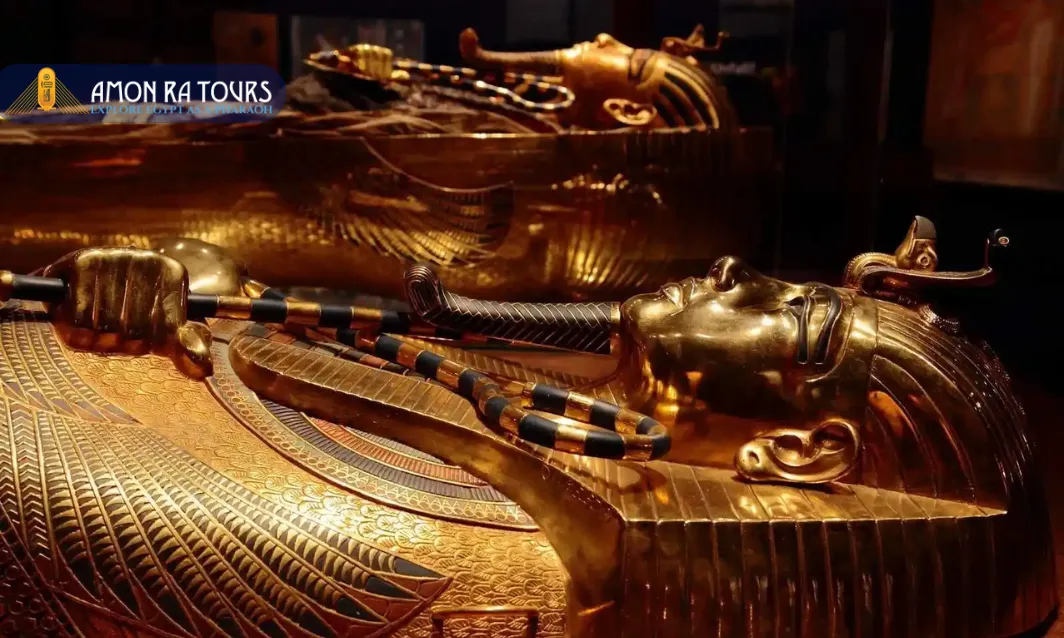
The Three Nested Coffins
- Outer coffin: Gilded wood
- Middle coffin: Gilded wood with glass inlays
- Inner coffin: 110kg solid gold (most valuable ancient object ever found)
The Canopic Shrine
- Four-sided gilded wooden shrine protecting canopic jars
- Each side guarded by a goddess (Isis, Nephthys, Neith, Selket)
- Jars held Tutankhamun’s preserved organs
The Meteorite Dagger
- Blade: Iron from meteorite (confirmed by spectral analysis, 2016 study)
- Handle: Gold with crystal pommel
- Significance: Iron was extremely rare in Bronze Age Egypt; its meteoric origin made it divine
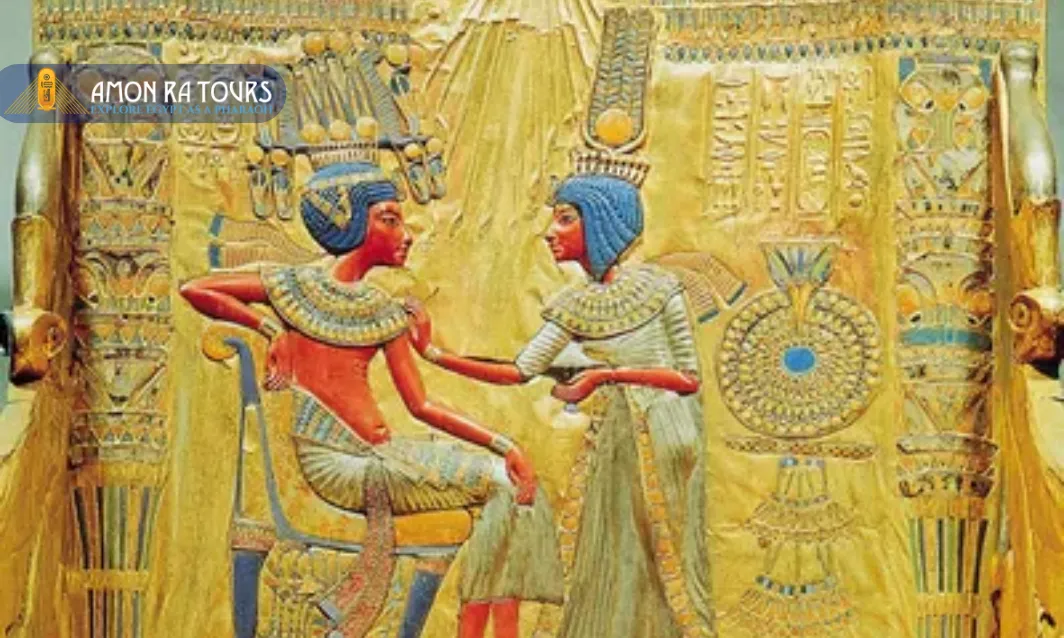
The Golden Throne
- Materials: Wood overlaid with gold, glass, faience
- Scene: Tutankhamun and Ankhesenamun in an intimate domestic moment (rare personal depiction)
- Details: Ankhesenamun adjusting Tut’s collar, sun rays (Aten) above, shows Amarna art influence despite religious restoration
The Chariots (6 Total)
- 2 war chariots: Lightweight, reinforced, designed for speed
- 4 ceremonial chariots: Elaborate decoration, used for hunting and processions
- Evidence: Tutankhamun participated in hunts despite disabilities (likely from a chariot, not on foot)
The Walking Sticks (130+)
- Why so many: Tutankhamun needed them constantly due to clubfoot
- Varieties: Simple canes, ornate ceremonial staffs, curved sticks
- Some inscribed: “May you live millions of years, you who love Thebes, sitting with your face to the north wind, your eyes beholding happiness”
Personal Items That Humanize the Pharaoh
Games:
- Senet board (popular Egyptian game)
- Dice
- Gaming pieces
Clothing:
- Linen tunics (over 100)
- Gloves
- Sandals (including pairs with enemy figures on soles—symbolically trampling Egypt’s foes)
- Undergarments
Jewelry:
- Rings, bracelets, earrings
- Pectorals with intricate inlays
- Amulets for protection
Food & Drink:
- Wine jars (labels showing vintage and vineyard)
- Dried meats
- Bread
- Honey
Cosmetics & Grooming:
- Mirrors (polished bronze)
- Razors
- Cosmetic containers
- Oils and unguents
Childhood Toys:
- Toy boats
- Small furniture
- Practice weapons
The Fetuses:
- Two mummified daughters
- Tiny coffins
- Tragic reminder of royal mortality
The Exhibition Experience
Modern design:
- Spacious galleries (no crowding)
- Perfect lighting (highlights gold without damaging artifacts)
- Climate control (preserves delicate materials)
- Interactive displays (showing tomb discovery, mummification process)
Layout:
- Chronological journey through Tutankhamun’s life and death
- Thematic sections (kingship, religion, military, daily life, burial)
- Culminates in a burial chamber recreation with golden shrines
How long to spend: 3-4 hours minimum to appreciate everything properly
Visitor tips:
- Book tickets in advance (online or through a tour operator)
- Visit weekday mornings for the smallest crowds
- Consider a guided tour for context (objects are more meaningful when you understand them)
- Photography allowed in most areas (no flash)
5 Fascinating Facts About King Tutankhamun
1. He Restored Egypt’s Ancient Gods After 17 Years of Ban
After his father, Akhenaten, tried to replace Egypt’s traditional polytheism with monotheistic Aten worship, Tutankhamun brought back the old gods and reopened their temples. The Restoration Stela documents this massive undertaking.
2. His Parents Were Full Siblings
DNA testing (JAMA, 2010) confirmed Tutankhamun’s mother and father were brother and sister. This inbreeding caused the genetic disorders (clubfoot, bone disease, weakened immune system) that contributed to his death at 19.
3. He Was Buried With His Two Stillborn Daughters
Two tiny mummified fetuses were found in his tomb. DNA analysis confirmed they were his daughters with his half-sister wife, Ankhesenamun. Both died before or shortly after birth, likely due to genetic issues from the parents’ close relationship.
4. His Sandals Had Enemies’ Faces on the Soles
Several pairs of sandals featured painted images of Egypt’s traditional enemies (Nubians, Asiatics, Libyans) on the soles. Every step Tutankhamun took symbolically trampled Egypt’s foes, psychological warfare through footwear.
5. His Tomb Inspired Global “Tut-Mania”
When his treasures toured the world (1960s-1970s), over 8 million people waited in lines to see them. The golden mask became the most recognizable artifact from the ancient world, spawning fashion trends, movies, songs, and an Egyptian tourism boom that continues today.
Plan Your Visit with Amon Ra Tours
Step into the world of ancient Egypt with Amon Ra Tours on the Grand Egyptian Museum Private Tour (Half Day in the New Egyptian Museum). Explore the breathtaking collection of Tutankhamun’s treasures, admire over five thousand royal artifacts, and feel the spirit of Egypt’s golden age come alive.
Book your private half-day tour today with Amon Ra Tours and enjoy a personalized journey through the world’s most anticipated museum, where history, art, and legend meet under one roof.
Conclusion
King Tutankhamun may have ruled for only a few short years, but his legacy has lasted for more than 3,000. His reign restored Egypt’s faith, revived its temples, and reconnected a divided kingdom with its ancient gods. The treasures discovered in his tomb revealed not just royal wealth, but the heart of a civilization that believed deeply in eternity.
Today, the King Tut accomplishments still inspire wonder across the world. His golden mask, his tomb, and his story remind us that greatness isn’t measured by years, but by the impact left behind.
Standing before his treasures at the Grand Egyptian Museum, visitors don’t just see history, they feel it. The boy king’s light still shines, brighter than gold, keeping Egypt’s ancient spirit alive for generations to come.
FAQs
1. What are the main King Tut accomplishments?
King Tutankhamun restored the worship of Egypt’s traditional gods after his father Akhenaten’s failed religious revolution. He reopened temples dedicated to Amun, rebuilt sacred monuments, and moved the capital back to Thebes. His leadership brought peace, stability, and a revival of Egypt’s art, culture, and religion.
2. Why is King Tut so famous?
King Tut is famous because his tomb was discovered nearly intact in 1922 by archaeologist Howard Carter. The treasures inside, including the iconic golden mask, offered an unmatched look at ancient Egyptian royal life and sparked worldwide fascination with Egyptology.
3. What does Tutankhamun’s name mean?
“Tutankhamun” means “the living image of Amun.” The name reflects his decision to restore the worship of Amun, Egypt’s most powerful god, after years of monotheistic rule under his father, Akhenaten. His earlier name, “Tutankhaten,” meant “the living image of Aten.”
4. How old was King Tut when he became pharaoh?
Tutankhamun became pharaoh around the age of nine and ruled Egypt for about ten years before his death at nineteen. Despite his youth, his reign marked a major turning point in restoring Egypt’s traditions and power.
5. How did King Tut die?
The exact cause of King Tutankhamun’s death remains a mystery. Modern CT scans and DNA tests suggest he suffered from malaria, bone disease, and possibly a leg fracture that became infected. There’s no confirmed evidence of murder, but his early death ended a critical chapter in Egypt’s 18th Dynasty.
6. Where can I see King Tut’s treasures today?
Tutankhamun’s treasures are displayed at the Grand Egyptian Museum in Giza. The exhibition includes over 5,000 artifacts, from his golden mask and coffins to jewelry, chariots, and daily items from his tomb, offering a complete glimpse into the life of Egypt’s most famous pharaoh.
🌟 Start Your Egyptian Adventure
Complete the form and let us create your perfect travel experience