


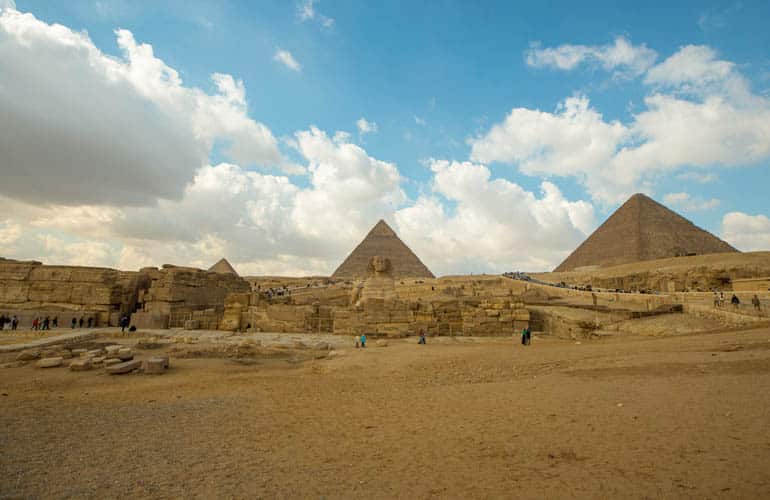
The Pyramids of Giza stand as humanity’s most enduring architectural achievement. Built 4,500 years ago on the desert plateau west of Cairo, these three monuments—Khufu, Khafre, and Menkaure—represent ancient Egypt’s mastery of engineering and their profound belief in eternal life.
What Are the Pyramids of Giza?
The Giza pyramid complex consists of three main pyramids built during Egypt’s Fourth Dynasty (2600-2500 BC). The site includes:
- The Great Pyramid of Khufu (Cheops) – the largest
- The Pyramid of Khafre (Chephren) – appears taller due to elevated ground
- The Pyramid of Menkaure (Mycerinus) – the smallest
- The Great Sphinx – guardian statue with a lion’s body and human head
- Queens’ pyramids – smaller pyramids for royal family members
These structures are the only surviving wonder of the ancient world and a UNESCO World Heritage Site.
The Three Great Pyramids: Dimensions and Facts
Pyramid of Khufu (The Great Pyramid)
- Original Height: 146.6 meters (481 feet)
- Current Height: 138.8 meters (455 feet)
- Base: 230.35 meters per side
- Blocks Used: ~2.3 million limestone blocks
- Weight: 5.9 million tons
- Construction Time: Approximately 20-27 years
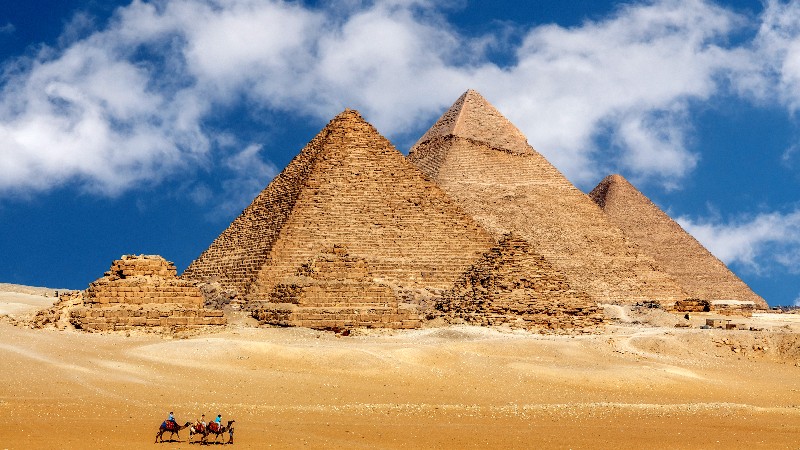
The Great Pyramid remained the world’s tallest structure for 3,800 years.
Pyramid of Khafre
- Height: 143.5 meters (471 feet)
- Base: 215.25 meters per side
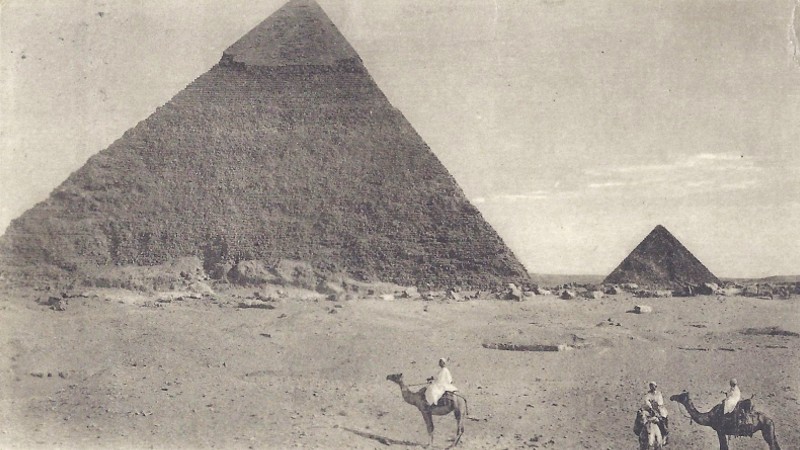
- Unique Feature: Retains some of its original smooth limestone casing at the peak
Pyramid of Menkaure
- Height: 66.4 meters (218 feet)
- Base: 108.04 meters per side
- Materials: Granite lower courses, limestone upper sections
Who Built the Pyramids?
Contrary to popular belief, enslaved people did not build the pyramids. Recent archaeological evidence by Egyptologists Mark Lehner and Zahi Hawass proves that skilled workers constructed these monuments.
The Workforce
- Number: 20,000-30,000 workers
- Type: Paid laborers, not slaves
- Organization: Skilled craftsmen, engineers, and seasonal agricultural workers
- Support System: Worker villages, bakeries, medical facilities
Lehner’s excavations revealed massive bakeries that produced thousands of loaves daily to feed the workforce. Hawass discovered workers’ tombs near the pyramids—proof they were honored citizens, not slaves.
Why They Built During Flood Season
The Nile flooded annually for 3-4 months, making farming impossible. Farmers became pyramid builders during this period, receiving food, shelter, and payment. This system transformed seasonal unemployment into national projects.

Why Were the Pyramids Built?
The pyramids served as royal tombs, designed to protect the pharaoh’s body for eternity and facilitate his journey to the afterlife.
Ancient Egyptian Beliefs
Ancient Egyptians believed:
- The soul (ka) is immortal
- The body must be preserved for resurrection
- After 3,000 years, the deceased would awaken in the afterlife
- Pharaohs became gods after death, joining the stars
Symbolic Location
The pyramids sit on the Nile’s west bank—where the sun sets—symbolizing the realm of the dead. This placement reflected Egyptian cosmology: east represented birth and life, west represented death and rebirth.
How Were the Pyramids Built?
Despite centuries of study, the exact construction methods remain debated. Here’s what archaeologists know:
Construction Process
- Quarrying: Workers cut limestone blocks using copper tools and wooden wedges
- Transportation: Blocks were dragged on sledges, likely lubricated with water
- Ramps: Internal or external ramps helped raise blocks (theories vary)
- Precision: Teams used plumb bobs, set squares, and star observations for alignment
- Assembly: Blocks were positioned with minimal gaps using simple tools
Engineering Genius
- Foundation: Built on solid bedrock for stability
- Alignment: Cardinal directions accurate to within 0.05 degrees
- Cornerstones: Ball-and-socket design to withstand earthquakes and thermal expansion
- Internal Structure: Multiple chambers and passages with sophisticated weight distribution
Pyramid Alignment with the Stars
The pyramids demonstrate remarkable astronomical knowledge.
Cardinal Direction Precision
Egyptologist Glen Dash proposed the “Indian Circle” method: ancient builders used a shadow-casting stick and rope to determine true north by tracking the sun’s shadow arc. This simple technique achieved extraordinary accuracy.
Orion’s Belt Connection
The three pyramids’ layout mirrors Orion’s Belt constellation as it appeared around 10,500 BC (accounting for Earth’s precession). Orion held special significance—Egyptians believed it was the dwelling place of Osiris, god of the afterlife.
- Khufu’s Pyramid → Alnitak (brightest star)
- Khafre’s Pyramid → Alnilam (middle star)
- Menkaure’s Pyramid → Mintaka (dimmest star, slightly offset)
The Nile’s position corresponds to the Milky Way in this celestial map.
Shaft Alignments
Four narrow shafts in Khufu’s pyramid pointed toward specific stars around 2500 BC:
- Northern shaft: Alpha Draconis (then the North Star)
- Southern shaft: Orion’s Belt
- Queen’s chamber shafts: Sirius and Beta Ursa Minor
These alignments helped the pharaoh’s soul ascend to join the gods.
 Camel yawns at the Pyramids of Giza
What the Pyramids Looked Like Originally
Today’s yellow limestone structures looked dramatically different when built.
Original Appearance
- Outer Casing: Brilliant white Tura limestone, polished to mirror-like smoothness
- Capstone: Possibly covered in gold or electrum (gold-silver alloy)
- Effect: Reflected sunlight, visible for miles—gleaming white monuments rising from golden desert
Most casing stones were removed over centuries to build Cairo’s mosques and buildings. Only Khafre’s pyramid retains some original casing near its peak.
Inside the Pyramids
Great Pyramid Interior
- Grand Gallery: 8.6-meter-high ascending passage
- King’s Chamber: Granite room containing an empty sarcophagus
- Queen’s Chamber: Smaller room (name is misleading—not for queens)
- Subterranean Chamber: Unfinished chamber carved into bedrock
- Air Shafts: Narrow passages to the exterior
Construction Mystery
The King’s Chamber contains a granite coffer too large to fit through the entrance passage—proving the pyramid was built around it, not placed inside afterward.
Interior Temperature
Despite Egypt’s scorching heat, the interior maintains a constant 20°C (68°F)—the Earth’s average temperature.
The Great Sphinx
Next to Khafre’s pyramid sits the Great Sphinx:
- Dimensions: 20 meters high, 73 meters long (not 46m as sometimes stated)
- Construction: Carved mostly from bedrock limestone
- Face: Likely represents Khafre himself
- Purpose: Guardian of the Giza necropolis
Visiting the Pyramids Today
Essential Information
- Location: Giza Plateau, 13 km southwest of Cairo
- Best Time: October-April (cooler weather), early morning for fewer crowds
- What to Bring: Water, sunscreen, comfortable shoes, sunglasses
- Entry: Interior visits require separate tickets (limited daily)
Photography Tips
- Golden hour (sunrise/sunset) provides best lighting
- Classic angle: all three pyramids visible from southeast viewpoint
- Camel and Sphinx shots available at designated areas
Pictures of Egyptian pyramids:



All you need to know in detail about Egypt Tour Packages & Tours
Interesting Facts About the Pyramids
- No Hieroglyphics: The Great Pyramid contains no interior writing or decorations
- Swivel Door: The original entrance had a 20-ton door that opened from inside but was invisible from outside
- Precise Mathematics: The pyramid’s perimeter divided by its height equals 2π (within 0.05%)
- Tallest Structure: Held the record for 3,871 years until Lincoln Cathedral (1311 AD)
- Stone Weight: Blocks range from 2.5 to 80 tons each
- Mortar Mystery: The mortar’s chemical composition remains unknown—and is stronger than the stones
Debunking Common Myths
Myth: Aliens built the pyramids Reality: Human ingenuity, organization, and thousands of skilled workers created these monuments
Myth: Hebrew slaves built them Reality: Archaeological evidence proves paid Egyptian workers built the pyramids centuries before the Biblical Exodus
Myth: They were built recently Reality: Extensive geological erosion, astronomical alignments, and contemporary Egyptian records confirm their ancient origin
Conservation Challenges
Modern threats include:
- Pollution: Cairo’s smog damages limestone
- Tourism: Millions of visitors cause wear
- Groundwater: Rising water table threatens foundations
- Climate Change: Increased erosion from extreme weather
The Egyptian government and UNESCO work continuously to preserve these irreplaceable monuments.
Why the Pyramids Matter Today
The Pyramids of Giza represent:
- Human Ambition: What organized societies can achieve
- Engineering Innovation: Solutions still studied by architects
- Cultural Legacy: Connection to our ancient past
- Inspiration: Reminder that greatness transcends time
Standing before these 4,500-year-old monuments, you witness humanity’s eternal quest to defy death and achieve immortality through creation.
Plan Your Visit: Check official Egyptian tourism websites for current ticket prices, opening hours, and guided tour options.
Frequently Asked Questions (FAQ)
How old are the Pyramids of Giza?
The Pyramids of Giza are approximately 4,500 years old, built between 2600-2500 BC during Egypt’s Fourth Dynasty under pharaohs Khufu, Khafre, and Menkaure.
How tall is the Great Pyramid of Giza?
The Great Pyramid (Khufu) originally stood 146.6 meters (481 feet) tall. Due to erosion and loss of the outer casing, it now measures 138.8 meters (455 feet).
Who actually built the pyramids?
Paid Egyptian workers—not slaves—built the pyramids. Archaeological evidence from Egyptologists Mark Lehner and Zahi Hawass confirms 20,000-30,000 skilled laborers, craftsmen, and seasonal farmers constructed these monuments.
How long did it take to build the Great Pyramid?
The Great Pyramid took approximately 20-27 years to complete, requiring year-round work by thousands of organized workers.
Can you go inside the pyramids?
Yes, visitors can enter the Great Pyramid and some smaller pyramids. Interior access requires separate tickets with limited daily availability. The climb involves narrow passages and steep angles.
Why were the pyramids built?
The pyramids served as elaborate tombs for pharaohs, designed to preserve their bodies and help their souls ascend to the afterlife. Ancient Egyptians believed proper burial ensured eternal life among the gods.
How were the pyramid blocks moved?
Workers likely dragged limestone blocks on wooden sledges lubricated with water. Recent experiments show wet sand reduces friction by 50%. Ramps—either external, internal, or spiral—helped raise blocks to higher levels.
Are the pyramids aligned with stars?
Yes. The pyramids align with cardinal directions to within 0.05 degrees accuracy. Their layout mirrors Orion’s Belt constellation, which ancient Egyptians associated with Osiris, god of the afterlife.
What’s inside the Great Pyramid?
The interior contains the Grand Gallery, King’s Chamber (with empty granite sarcophagus), Queen’s Chamber, subterranean chamber, and narrow air shafts. No treasure or hieroglyphics remain inside.
How many blocks are in the Great Pyramid?
The Great Pyramid contains approximately 2.3 million limestone blocks, each weighing 2.5 to 80 tons.
Why are the pyramids on the west side of the Nile?
The west bank symbolized the realm of the dead in ancient Egyptian belief, as the sun sets in the west. East represented life and rebirth, west represented death and the afterlife.
What happened to the pyramid’s white casing?
The original polished white limestone casing was removed over centuries to build Cairo’s mosques and buildings. Only Khafre’s pyramid retains some original casing near its peak.
How much does it cost to visit the pyramids?
Ticket prices vary: general admission to the Giza Plateau (around 540 EGP/$18 for foreigners), interior pyramid access (additional 400-500 EGP/$13-16). Prices change frequently—check official sources before visiting.
What is the best time to visit the pyramids?
Visit between October-April for cooler weather. Arrive early morning (8-9 AM) to avoid crowds and intense heat. Sunset offers spectacular photography opportunities.
Is the Sphinx part of the pyramid complex?
Yes. The Great Sphinx sits next to Khafre’s pyramid as guardian of the necropolis. It measures 20 meters high and 73 meters long, carved from bedrock limestone.
🌟 Start Your Egyptian Adventure
Complete the form and let us create your perfect travel experience