


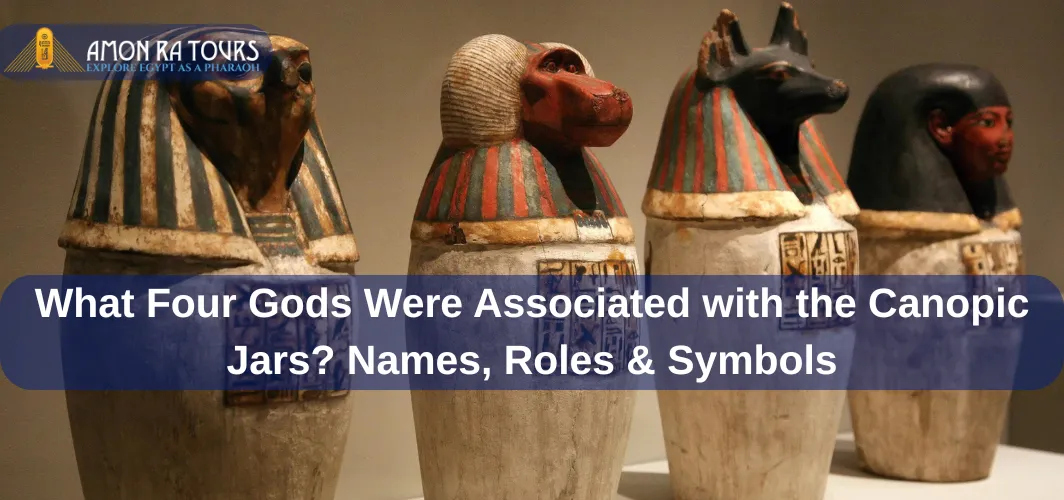
What four gods were associated with the canopic jars? The answer is the Four Sons of Horus: Imsety, Hapy, Duamutef, and Qebehsenuef. These divine protectors guarded the internal organs of mummified Egyptians, each god watching over a specific organ in specially designed jars used during ancient Egyptian mummification.
Quick Answer:
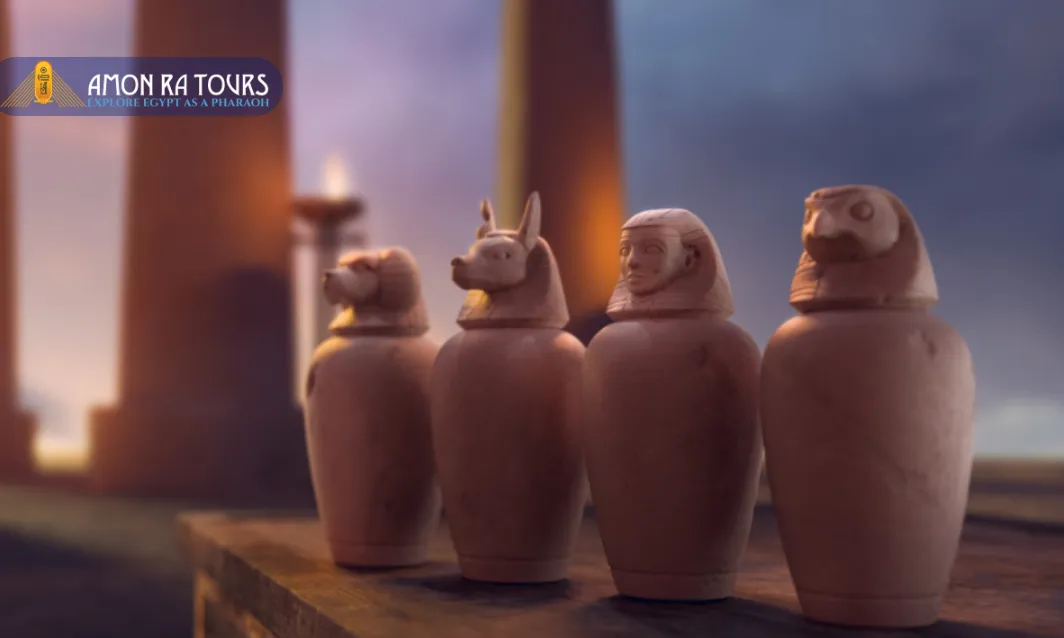
- Imsety (human head) → protected the liver
- Hapy (baboon head) → protected the lungs
- Duamutef (jackal head) → protected the stomach
- Qebehsenuef (falcon head) → protected the intestines
These four gods were the sons of Horus, one of Egypt’s most powerful deities. Ancient Egyptians believed these gods literally inhabited the canopic jars, transforming simple containers into divine vessels that ensured safe passage to the afterlife.
The Four Gods of Canopic Jars: Quick Reference
| God | Head Shape | Organ Protected | Direction | Goddess Protector | Symbolism |
| Imsety | Human | Liver | South | Isis | Emotion, passion, humanity |
| Hapy | Baboon | Lungs | North | Nephthys | Breath, wisdom, life force |
| Duamutef | Jackal | Stomach | East | Neith | Nourishment, rebirth, strength |
| Qebehsenuef | Falcon | Intestines | West | Selket | Purification, afterlife journey |
Why this matters: The four gods associated with the canopic jars weren’t randomly chosen. Each god’s animal form, organ assignment, and directional placement created a complete spiritual protection system for the deceased’s journey to the afterlife.
Who Were the Four Sons of Horus?
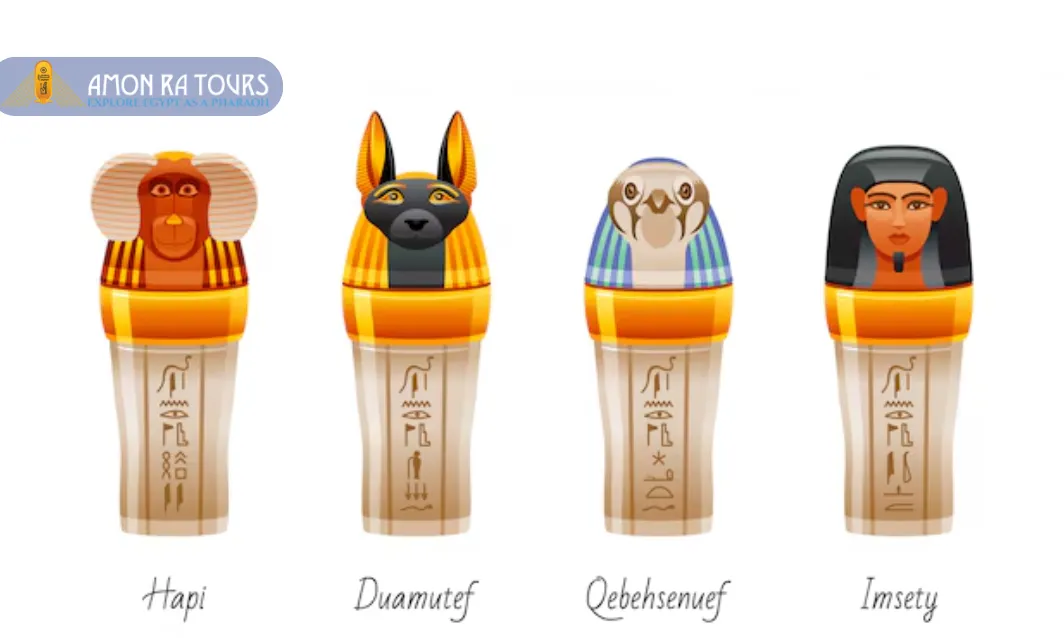
The four gods associated with the canopic jars were known collectively as the Four Sons of Horus. According to Egyptian mythology, they were born from a lotus flower that emerged from the primordial waters, linking them to creation, rebirth, and cosmic order.
Why They Were Called “Sons of Horus”
Horus was one of ancient Egypt’s most important deities, the falcon-headed god of kingship, the sky, and protection. As his sons, these four gods inherited his protective power and divine authority, making them ideal guardians for the vulnerable organs of the dead.
First mentioned: Pyramid Texts (c. 2400 BCE)
Role evolution: Originally general protectors → specifically assigned to canopic jars during the Middle Kingdom (c. 2000 BCE)
Divine purpose: Create a spiritual shield around the deceased from all four cardinal directions
The Lotus Birth Story
Ancient texts describe the Four Sons of Horus emerging from a lotus flower in the waters of creation. This lotus birth symbolized:
- Purity: Lotus rises from mud but blooms pristine
- Rebirth: Lotus closes at night, reopens at dawn
- Divine origin: Lotus associated with sun god Ra’s daily rebirth
This creation myth established the four gods as fundamentally connected to resurrection, exactly what mummification aimed to achieve.
Why Did Ancient Egyptians Use Canopic Jars?
Before explaining what four gods were associated with the canopic jars in detail, understanding WHY Egyptians used these jars reveals their spiritual importance.
The Mummification Necessity
Ancient Egyptians believed the body must be preserved intact for resurrection in the afterlife. However, internal organs decay rapidly, within hours in Egypt’s heat. The solution: remove organs, preserve them separately in canopic jars.
Organs removed and placed in jars:
- Liver (metabolic center)
- Lungs (breath of life)
- Stomach (nourishment processor)
- Intestines (purification system)
Organ kept in the body:
- Heart (Egyptians believed it held intelligence, memory, personality, needed for afterlife judgment)
Organ removed but discarded:
- Brain (pulled through the nose, thrown away, Egyptians didn’t know its function)
Imsety: The Human-Headed God (Liver Protector)
What Imsety Protected
Organ: Liver
Why the liver mattered: Ancient Egyptians believed the liver was the source of emotion, passion, and courage. Protecting it meant preserving the deceased’s emotional essence for eternity.
Imsety’s Symbolism
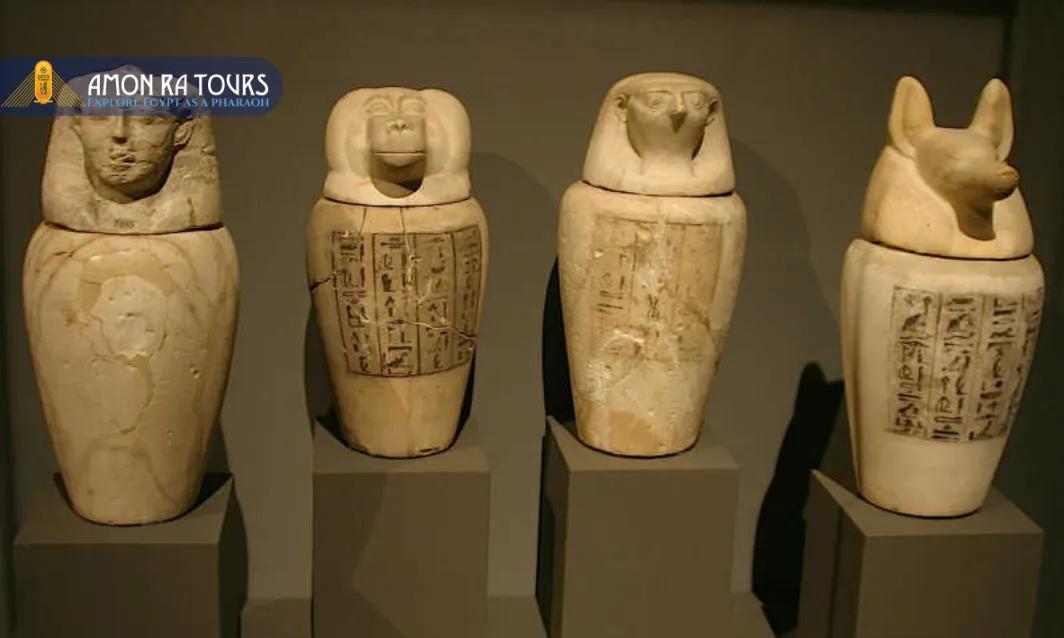
Human head: Unlike his brothers with animal heads, Imsety appeared completely human. This symbolized:
- Connection between mortal and divine realms
- Humanity’s place in cosmic order
- Accessibility (commoners felt closer to a human-headed god)
Name meaning: “The one who is in his wrappings”, directly referencing mummification’s linen bandages
Direction: South (sun at its peak, warmth, vitality)
Goddess protector: Isis (most powerful goddess, ideal mother, magician)
Color association: Red (life, energy, blood)
Imsety in Archaeological Finds
Imsety was the most popular of the four gods among common Egyptians. Archaeological evidence shows:
- More protective amulets bore Imsety’s image than other sons
- His human form made him more relatable
- Families often placed additional Imsety charms in tombs
- Prayers to Imsety appear most frequently in burial texts
Modern discovery: 2018 excavation at Saqqara revealed a tomb with 40+ canopic jars; 18 were Imsety’s liver jars, suggesting his special importance to that family.
Hapy: The Baboon-Headed God (Lungs Protector)
What Hapy Protected
Organ: Lungs
Why lungs mattered: Breath was synonymous with life itself. The Egyptian word for “breath” (tjau) was closely related to the word for “life” (ankh). Protecting lungs meant preserving the ability to breathe, speak spells, and invoke divine names in the afterlife.
Hapy’s Symbolism
Baboon head: In ancient Egypt, baboons symbolized:
- Wisdom and knowledge (connection to Thoth, god of wisdom)
- Alertness (baboons are vigilant, vocal animals)
- Dawn worship (Egyptians observed baboons “greeting” sunrise with calls)
Name: Not to be confused with Hapi (the Nile god), different spelling, different deity
Direction: North (imperishable stars, stability, eternal order)
Goddess protector: Nephthys (sister of Isis, protector of the dead)
Color association: Blue (sky, heaven, breath, divinity)
Hapy’s Connection to Speech
Ancient Egyptians believed speaking sacred spells was crucial for navigating the afterlife. Specifically:
- Spell 125 (Book of the Dead): Required the deceased to verbally deny sins before 42 judges
- Spell 6: Activated shabti workers through spoken command
- Opening of the Mouth ceremony: Restored the ability to breathe and speak
By protecting the lungs, Hapy ensured the deceased retained these vital capabilities.
Baboons as Divine Announcers
Temple reliefs show baboons with raised arms greeting Ra at sunrise. Hapy embodied this role as divine announcer, warning against spiritual threats while proclaiming the deceased’s arrival in the afterlife.
Duamutef: The Jackal-Headed God (Stomach Protector)
What Duamutef Protected
Organ: Stomach
Why the stomach mattered: The stomach processes nourishment, extracting strength from food. In the afterlife, Egyptians believed they would feast at Osiris’s table; a functioning stomach was essential for enjoying eternal banquets.
Duamutef’s Symbolism
Jackal head: Jackals were cemetery guardians in Egyptian belief because:
- They naturally inhabited desert burial grounds
- Their nocturnal vigilance symbolized constant watchfulness
- Connection to Anubis (jackal-headed god of embalming)
- Sharp senses detected intruders before they reached tombs
Name meaning: “He who praises” or “He who worships”, referencing prayers for the deceased
Direction: East (sunrise, rebirth, renewal, new beginnings)
Goddess protector: Neith (ancient warrior goddess, wise counselor)
Color association: Yellow/Gold (sunrise, new life, divine radiance)
Duamutef as Warrior Guardian
Ancient funerary texts describe Duamutef as a fierce warrior among the Four Sons:
- Armed with knives to fight demons
- Patrolling the tomb perimeter with jackal senses
- Detecting threats through supernatural smell and hearing
- Most aggressive defender against evil spirits
Pyramid Text 690: “Duamutef, son of Horus, the jackal-headed one, drives away your enemies; he protects your belly.”
Eastern Placement Significance
Placing Duamutef’s jar facing east meant every sunrise brought:
- Fresh protective energy
- Renewal of defensive power
- Connection to Ra’s daily rebirth
- Symbolic “refeeding” of the stomach with light
Qebehsenuef: The Falcon-Headed God (Intestines Protector)
What Qebehsenuef Protected
Organ: Intestines
Why intestines mattered: The intestines were the body’s longest organ and most difficult to preserve. They were also associated with purification, removing waste, and cleansing the body. Protecting them symbolized spiritual purification for the afterlife.
Qebehsenuef’s Symbolism
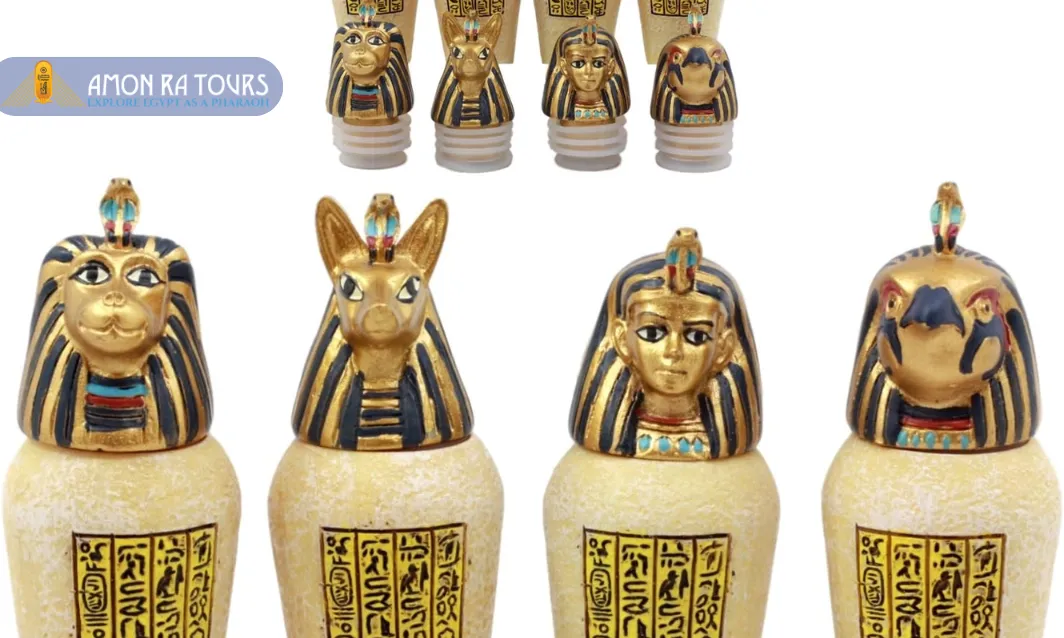
Falcon head: Falcons represented:
- Royal power (Horus himself was falcon-headed)
- Divine vision (falcons see prey from great distances)
- Sky dominion (falcons soar highest)
- Swift, decisive action
Name meaning: “He who cools his brothers” (possibly referencing his role in purification or in providing refreshing winds)
Direction: West (setting sun, entrance to underworld, land of the dead)
Goddess protector: Selket (scorpion goddess, healer, protector against venom and poison)
Color association: Black (rebirth, fertile soil, regeneration, underworld)
Western Gateway Guardian
Qebehsenuef’s western placement was deeply significant:
- West = afterlife entrance: Where the sun “died” each evening
- Hathor’s domain: Goddess of the west welcomed the dead
- Final journey: The West was where souls departed the mortal world
- Spiritual transition: From life (east) to afterlife (west)
By guarding the western jar, Qebehsenuef literally stood at the gateway between worlds.
Falcon Powers in Protection
Texts describe Qebehsenuef’s unique abilities:
- Aerial vision: Detected threats from the sky before they reached earth
- Wind summoning: Called upon the winds to scatter evil spirits
- Swift strikes: Attacked demons with falcon speed and talons
- Sky authority: Commanded celestial forces
Coffin Text 151: “Qebehsenuef, the falcon-headed one, spreads his wings over you, no evil shall approach from the western sky.”
How Canopic Jars Actually Worked in Burials
The Mummification Process
Step 1: Organ Removal (Days 1-2)
- Embalmers made a left-sided incision in the abdomen
- Carefully removed liver, lungs, stomach, intestines
- Heart deliberately left in body (needed for judgment)
- The brain was removed through the nose and discarded
Step 2: Organ Preservation (Days 3-40)
- Each organ was washed with palm wine (disinfectant)
- Dried with natron salt for 40 days
- Wrapped in linen with protective amulets
- Sometimes treated with resins and oils
Step 3: Jar Preparation (During mummification)
- Priests performed “Opening of the Mouth” on jars
- Incense burned to purify vessels
- Spells recited to invite gods into jars
- Offerings placed before each jar
Step 4: Organ Placement (Day 70)
- Each preserved organ is placed in its designated jar
- Lids sealed with resin or wax
- Additional protective spells are inscribed if space allows
- Jars positioned in the anopic chest
The Canopic Chest Arrangement
Canopic jars weren’t randomly placed; their arrangement followed cosmic principles:
NORTH
(Hapy)
WEST EAST
(Qebehsenuef) (Duamutef)
SOUTH
(Imsety)
This formation created a protective square or “mandala”:
- Four corners = four pillars of heaven
- Four directions = complete coverage
- Four gods = balanced divine power
- Sacred geometry = cosmic harmony
The chest itself often featured:
- Hieroglyphic spells on all four sides
- Images of protective deities
- Royal cartouches (for pharaohs)
- Gilding or precious stone inlay (for the elite)
Placement in the Tomb
Standard position: Canopic chest placed near the sarcophagus, usually at the foot end or to the side
Reasoning:
- Organs needed to be close to the body for the afterlife reunion
- But not so close that tomb robbers would find them immediately
- Some tombs had special canopic niches carved into the walls
- Royal tombs sometimes had separate canopic chambers
Protection layers:
- Wrapped organs (inner protection)
- Sealed jars (container protection)
- Canopic chest (group protection)
- Tomb chamber (outer protection)
- Divine spells throughout (spiritual protection)
Evolution of Canopic Jars Through Egyptian History
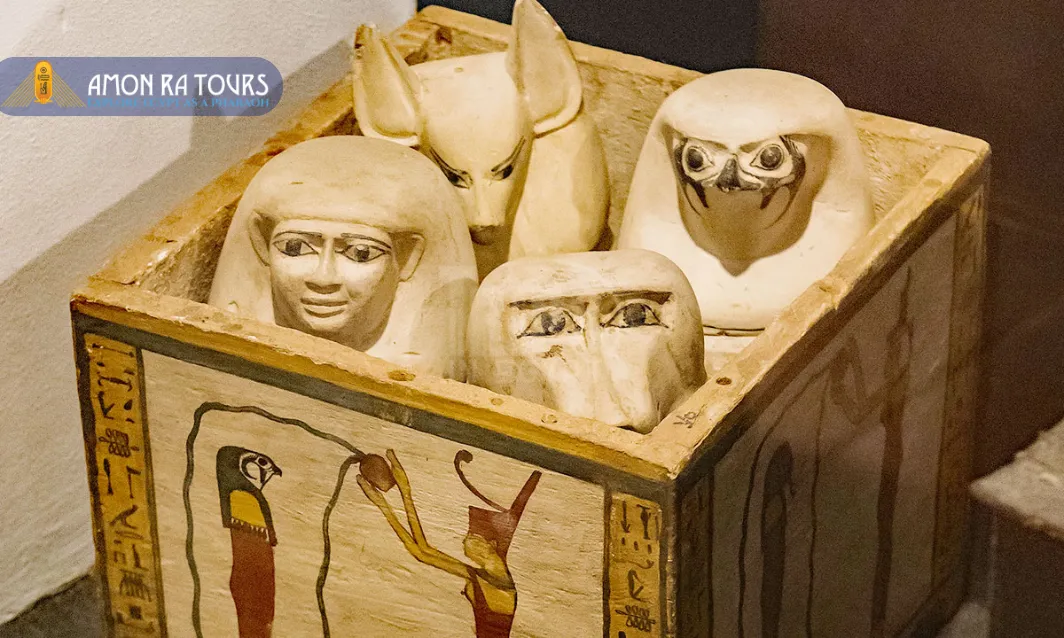
Old Kingdom (2686-2181 BCE): Early Development
Characteristics:
- Simple pottery or stone jars
- All four lids had human heads (representing deceased, not gods)
- No specific god associations yet
- Organs wrapped separately before jar placement
Why: The Canopic jar tradition was just beginning, and theological concepts were still developing
Middle Kingdom (2055-1650 BCE): The Four Sons Arrive
Major change: Introduction of the Four Sons of Horus concept
Characteristics:
- Jars still mostly had human-headed lids
- But spells now invoked Imsety, Hapy, Duamutef, Qebehsenuef by name
- Beginning of the directional placement system
- Goddess protectors were added during this period
Why: Expanding religious texts (Coffin Texts) detailed a more complex afterlife journey requiring specialized divine protection
New Kingdom (1550-1077 BCE): Golden Age of Canopic Jars
Major change: Animal-headed lids became standard
Characteristics:
- Distinctive heads: human, baboon, jackal, falcon
- High-quality materials (alabaster, calcite, sometimes gold)
- Elaborate hieroglyphic inscriptions
- Sophisticated artistic detail
- Canopic chests became art masterpieces
Famous examples:
- Tutankhamun’s canopic jars: Made of calcite (alabaster), with stoppers carved as miniature royal coffins, protected by a shrine with four goddesses
- Yuya and Thuya: Beautifully preserved jars with detailed inscriptions
- Ramses II’s family: Multiple sets of elaborate royal canopic equipment
Why: The New Kingdom was Egypt’s golden age, with wealth, stability, and religious sophistication at its peak
Late Period (664-332 BCE): Artistic Elaboration
Characteristics:
- Even more decorative details
- Sometimes the entire body of God is depicted, not just the head
- Precious metal inlays (gold, silver, lapis lazuli)
- Complex spell programs covering the entire jar surface
- Regional style variations
Innovation: Some jars are designed to be reopened, allowing families to add offerings after burial
Ptolemaic & Roman Periods (332 BCE – 395 CE): Decline
Changes:
- Greek artistic influences blend with Egyptian traditions
- Dummy jars appear (sealed shut, organs actually left in the body)
- Quality varies widely, some exquisite, others crude
- Practice gradually abandoned as embalming methods change
Why decline:
- Greek burial customs didn’t use canopic jars
- Roman cremation practices spread
- Christianity’s rise discouraged mummification
- Economic decline reduced resources for elaborate burials
Final use: The Last documented canopic jars date to around 100 CE
Symbolism Beyond Organ Protection
The Number Four
Four was sacred in Egyptian cosmology:
- Four cardinal directions: North, South, East, West
- Four corners of heaven: Held up by four gods
- Four elements: Earth, air, fire, water (later Greek, but the Egyptians had similar concepts)
- Four winds: Divine breath from all directions
- Four faces of Re: Sun god’s transformations
The four gods associated with the canopic jars embodied this universal principle of cosmic balance through the number four.
Color Symbolism on Jars
Painted canopic jars used specific colors with deep meanings:
Red (Imsety/liver):
- Life force and blood
- Energy and passion
- Protection against evil (red was apotropaic)
Blue (Hapy/lungs):
- Sky and heavens
- Divine breath
- Lapis lazuli = most precious material
Yellow/Gold (Duamutef/stomach):
- Sunrise and rebirth
- Eternal, incorruptible gold
- Divine flesh of gods
Black (Qebehsenuef/intestines):
- Fertile Nile soil (life from death)
- Regeneration and rebirth
- Underworld passages
Where to See Canopic Jars Today
Cairo: The World’s Best Collections
Egyptian Museum (Tahrir Square)
- What to see: Tutankhamun’s canopic shrine and jars (calcite with gold), dozens of complete sets from various periods
- Highlights: Room 3 (ground floor) – Yuya and Thuya’s beautifully preserved jars
- Best for: Seeing multiple styles across dynasties
Grand Egyptian Museum (GEM)
- What to see: Tutankhamun’s complete canopic equipment (relocated from the old museum), interactive displays explaining mummification
- Highlights: Full canopic shrine with goddess figures, detailed labeling of the Four Sons of Horus
- Best for: Modern presentation with context
National Museum of Egyptian Civilization (NMEC)
- What to see: Canopic jars displayed alongside royal mummies, they once protected
- Highlights: Shows the connection between jars and actual preserved bodies
- Best for: Understanding the complete mummification process
Luxor: In Original Context
Valley of the Kings
- What to see: Tomb niches and chambers where canopic chests originally stood
- Notable tombs:
- KV62 (Tutankhamun) – canopic shrine location visible
- KV17 (Seti I) – elaborate canopic chamber
- KV35 (Amenhotep II) – canopic cache discovery site
- Entry: 500 EGP standard ticket + extra fees for special tombs
- Best for: Seeing where jars functioned in ancient tombs
Luxor Museum
- What to see: Beautifully displayed canopic jars from Theban tombs
- Highlights: Well-lit, English labels, less crowded than Cairo museums
- Best for: Quality over quantity, intimate viewing
Fascinating Facts About Canopic Jars
Archaeological Surprises
Hidden treasures inside jars: X-ray scanning revealed that some jars contained:
- Jewelry and amulets placed with organs
- Precious stones for added protection
- Small figurines of protective deities
- Gold leaf wrappings
Reused jars: Some families reused canopic jars from older burials, erasing previous names and inscribing new ones (ancient recycling!)
Miniature jars: Smallest canopic jars ever found measured just 3 inches tall, made for infant burials with the same protective symbolism
Giant jars: The Largest known canopic jars reached 4 feet tall, created for pharaohs to match their monumental sarcophagi
Regional Variations
Thebes (Luxor): Preferred calcite (alabaster) with refined carving
Memphis (near Cairo): Often used limestone with painted decoration
Provincial sites: Pottery jars with simpler designs but the same divine protection
Nubian border: Egyptian-Nubian hybrid styles showing cultural exchange
3 Nights Nile Cruise from Aswan
Conclusion
What four gods were associated with the canopic jars? Imsety, Hapy, Duamutef, and Qebehsenuef, the Four Sons of Horus, who protected the vital organs of mummified Egyptians for over 2,000 years.
Experience Canopic Jars With Amon Ra Tours
Why choose Amon Ra Tours for your Egyptian museum journey:
Expert Egyptologists: Our licensed guides explain the Four Sons of Horus, decode hieroglyphic spells on jars, and reveal symbolism invisible to untrained eyes
Strategic museum tours: Visit Egyptian Museum + GEM + NMEC to see Tutankhamun’s complete canopic shrine, compare styles across periods, and understand the mummification process
Valley of the Kings context: Combine Cairo museums with Luxor tomb visits, see jars in museums, then see the original niches where they protected pharaohs
Book your Ancient Egyptian Mummification & Canopic Jars Tour and discover the four gods who protected Egypt’s eternal journey.
FAQ
Why did each canopic jar god have a different animal head?
Each animal head symbolized specific divine qualities:
- Human (Imsety): Connection to humanity and mortal world
- Baboon (Hapy): Wisdom, alertness, dawn greeting
- Jackal (Duamutef): Cemetery guardianship, vigilance, Anubis connection
- Falcon (Qebehsenuef): Royal power, divine vision, sky dominion
The different forms created diverse protection; no single threat could overcome all four.
Which direction did each canopic jar face?
The four canopic jars were positioned according to cardinal directions:
- Imsety (liver): South
- Hapy (lungs): North
- Duamutef (stomach): East
- Qebehsenuef (intestines): West
This arrangement created 360-degree spiritual protection from all compass points.
What goddesses protected the canopic jars?
Four goddesses partnered with the Four Sons of Horus:
- Isis protected Imsety’s liver jar
- Nephthys protected Hapy’s lungs jar
- Neith protected Duamutef’s stomach jar
- Selket protected Qebehsenuef’s intestines jar
These goddess-god pairs doubled the protective power through complementary divine energies.
Why wasn’t the heart placed in a canopic jar?
Ancient Egyptians believed the heart was the seat of intelligence, memory, and personality, not the brain (which they discarded). The heart remained in the body because it was needed for the “Weighing of the Heart” ceremony in the afterlife, where it was weighed against the feather of Ma’at (truth). A pure heart allowed entry to paradise; without it, resurrection was impossible.
When did ancient Egyptians start using canopic jars?
Canopic jars first appeared during the Old Kingdom (around 2600 BCE). Early versions had human-headed lids representing the deceased. The Four Sons of Horus were introduced during the Middle Kingdom (around 2000 BCE), and the distinctive animal-headed lids became standard during the New Kingdom (around 1550 BCE).
What materials were canopic jars made from?
Common materials included:
- Limestone: Most common for middle-class burials
- Calcite (alabaster): Preferred for elite and royal burials
- Pottery: Used for lower-status burials
- Gold and silver: Very rare, only for the highest royalty
- Wood: Occasionally used, rarely survived
Wealthier families commissioned more expensive materials and elaborate decoration.
Did all ancient Egyptians use canopic jars?
No. Canopic jars were expensive and primarily used by:
- Royalty and nobility: Always used full sets with the finest materials
- Wealthy merchants and priests: Used simpler versions
- Middle class: Sometimes used basic pottery jars
- Common people: Rarely used jars; organs sometimes wrapped and placed back in the body cavity
Mummification quality and equipment directly reflected social status and wealth.
Where can I see the best examples of canopic jars?
Best collections worldwide:
- Egyptian Museum, Cairo: Tutankhamun’s canopic shrine, the largest variety
- Grand Egyptian Museum, Cairo: Modern display with context
- British Museum, London: Extensive collection across all periods
- Louvre, Paris: Royal sets with excellent preservation
- Metropolitan Museum, New York: Well-curated with educational materials
For authentic context: Valley of the Kings (Luxor) shows original tomb niches where canopic chests stood.
🌟 Start Your Egyptian Adventure
Complete the form and let us create your perfect travel experience