


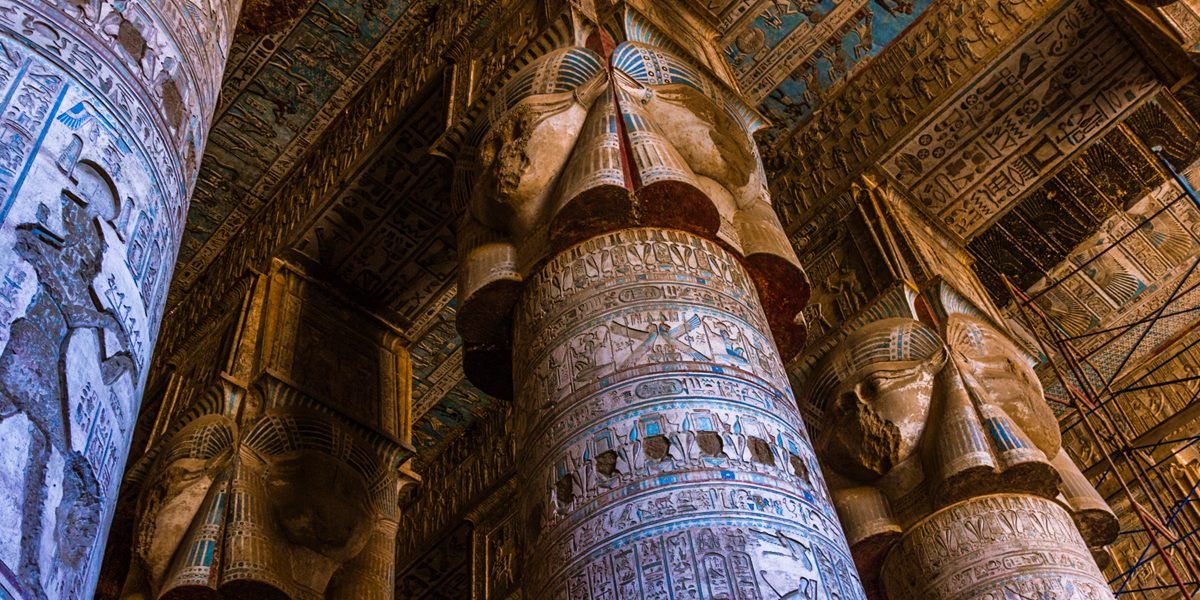
Quick answer: The Temple of Dendera is dedicated to Hathor, the ancient Egyptian goddess of love, music, joy and healing, and it was a place of pilgrimage and healing in ancient times. Today its well-preserved halls, painted sky ceiling, rooftop chapels and quiet crypts make it one of the most atmospheric temples in Egypt for reflection and quiet meditation.
What is the Temple of Dendera?
Dendera lies on the west bank of the Nile near the city of Qena, north of Luxor. The main temple, dedicated to Hathor, was built mostly in the Ptolemaic and early Roman periods, but it stands on a site that was sacred for far longer. It is one of the most complete temples in Egypt: the roof, staircases, chapels and much of the original colour have survived.
Inside the temple enclosure you will also find birth houses (mammisi) linked to the divine child, a sacred lake, a small Christian basilica, and the remains of a sanatorium where ancient visitors came hoping to be healed by the goddess.
Plan your visit: Amon Ra Tours arranges a private day trip to the temples of Abydos and Dendera from Luxor with a professional Egyptologist guide. For group journeys built around meditation and sacred sites, see our Egypt retreats page.
Who was Hathor?
Hathor was one of the most loved goddesses of ancient Egypt. She was linked with love, music, dance, joy, motherhood and the sky, and was often shown as a woman with cow’s ears or with a sun disc between cow horns. Her symbol, the sistrum, was a rattle played in rituals to please the gods and drive away negative forces.
Each year a festival carried Hathor’s statue by river from Dendera to the Temple of Horus at Edfu, celebrating her sacred union with Horus. This link between the two temples is one reason Dendera fits naturally into a Nile journey.
Why spiritual travelers are drawn to Dendera
- A temple of joy and healing: Hathor’s themes of love, music and renewal make Dendera feel gentler than many temples dedicated to war or kingship.
- The sky ceiling: the hypostyle hall’s ceiling, cleaned and restored in recent years, shows the sky goddess Nut, the hours of day and night, and the stars in vivid blue.
- The rooftop chapels: staircases decorated with processions lead to the roof, where small chapels were used for the rites of Osiris. One holds a cast of the famous circular Dendera Zodiac; the original is in the Louvre in Paris.
- The crypts: narrow hidden chambers inside the walls, carved with reliefs. One relief is sometimes called the “Dendera light” by alternative-history writers who see an ancient lamp in it; Egyptologists read it as a lotus flower and snake from a creation myth.
Many visitors say Dendera carries a calm, uplifting “energy.” Such experiences are personal and belong to belief and spiritual tradition rather than measurable science — but the silence, colour and craftsmanship of the temple are moving for almost everyone.
What is allowed inside the temple?
- Quiet personal meditation: generally fine in the halls and on the roof, as long as you don’t block paths or other visitors.
- Don’t touch the reliefs or ceiling colours: the paintwork is fragile and recently restored.
- Chanting, sound healing, group circles, candles or incense: not standard visitor activities. They require permission from the site authorities, which must be requested and confirmed in advance.
- Crypts and roof: access can change with conservation work and site conditions, so check on the day with your guide.
- Photography and drones: rules change; drones need official permits in Egypt.
How to visit Dendera
Dendera is usually visited from Luxor, roughly one to one and a half hours away by road. Many travelers combine it with the Temple of Seti I at Abydos in a full day, or visit Dendera on its own as a half-day trip. Some Nile cruises and dahabiyas also include it in longer itineraries.
Go early or in the late afternoon for softer light and fewer people, and allow time to climb to the roof. Opening hours and ticket prices should be confirmed shortly before your visit.
Related guides
Read about meditating at Abydos and the Osireion, our guide to the best places in Egypt for meditation, or explore chakras and the sacred sites of Egypt. Planning a group program? See how to organize a retreat in Egypt.
Frequently asked questions
What is the Temple of Dendera known for?
Dendera is known for its Temple of Hathor, one of the best-preserved temples in Egypt, with a painted astronomical ceiling, rooftop chapels, hidden crypts and a cast of the famous Dendera Zodiac.
Can you meditate at Dendera Temple?
Quiet personal meditation is generally possible as long as you respect other visitors and the monument. Group rituals, chanting, candles or incense need advance permission from the site authorities.
Where is the original Dendera Zodiac?
The original circular Dendera Zodiac was removed in the 19th century and is now in the Louvre Museum in Paris. A cast is displayed in its original rooftop chapel at Dendera.
How far is Dendera from Luxor?
Dendera is roughly one to one and a half hours by road north of Luxor, so it can be visited as a half-day trip or combined with Abydos in a full day.
Can Amon Ra Tours arrange a spiritual visit to Dendera?
Yes. Amon Ra Tours can arrange a private visit to Dendera, alone or with Abydos, with a professional Egyptologist guide and time for quiet reflection. Any special access or group activity is requested in advance and depends on official approval.
🌟 Start Your Egyptian Adventure
Complete the form and let us create your perfect travel experience
Plan your trip with Amon Ra Tours
Private tours with a professional Egyptologist guide, hotel pickup and an air-conditioned vehicle. See our Luxor day tours and Luxor and Aswan Nile cruises, or tell us your dates and we will plan it for you.