


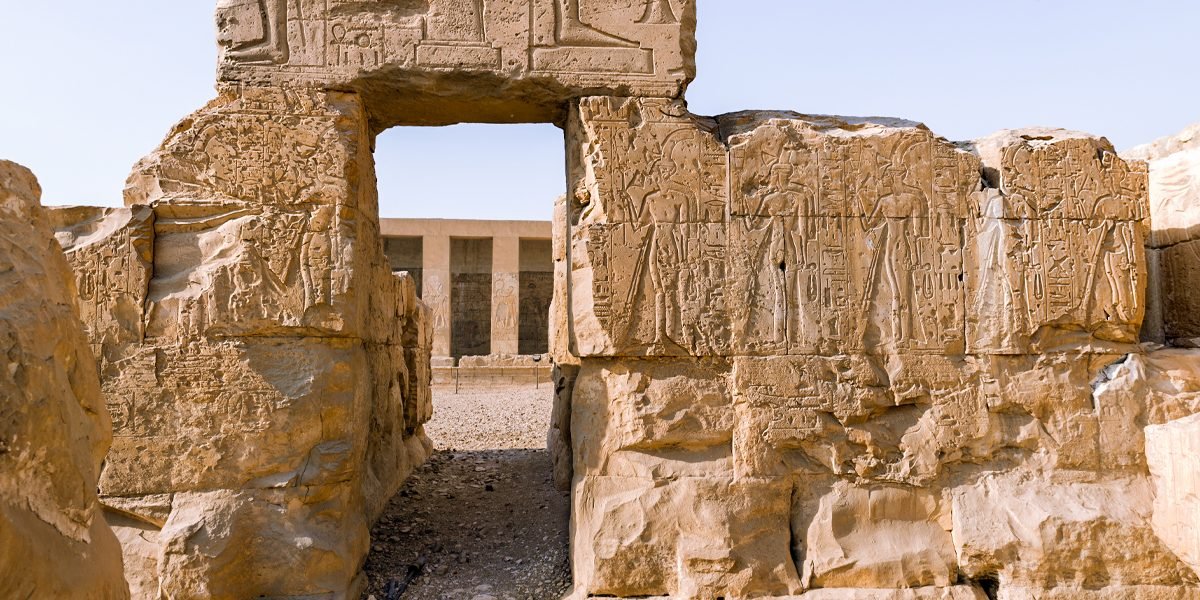
Quick answer: Yes — visitors can sit quietly and meditate inside the Temple of Seti I at Abydos, one of the calmest and best-preserved temples in Egypt. The Osireion behind it is usually seen from the viewing area above; going down into it, or holding a group ritual or chanting session, is not standard and must be arranged and confirmed with the authorities in advance.
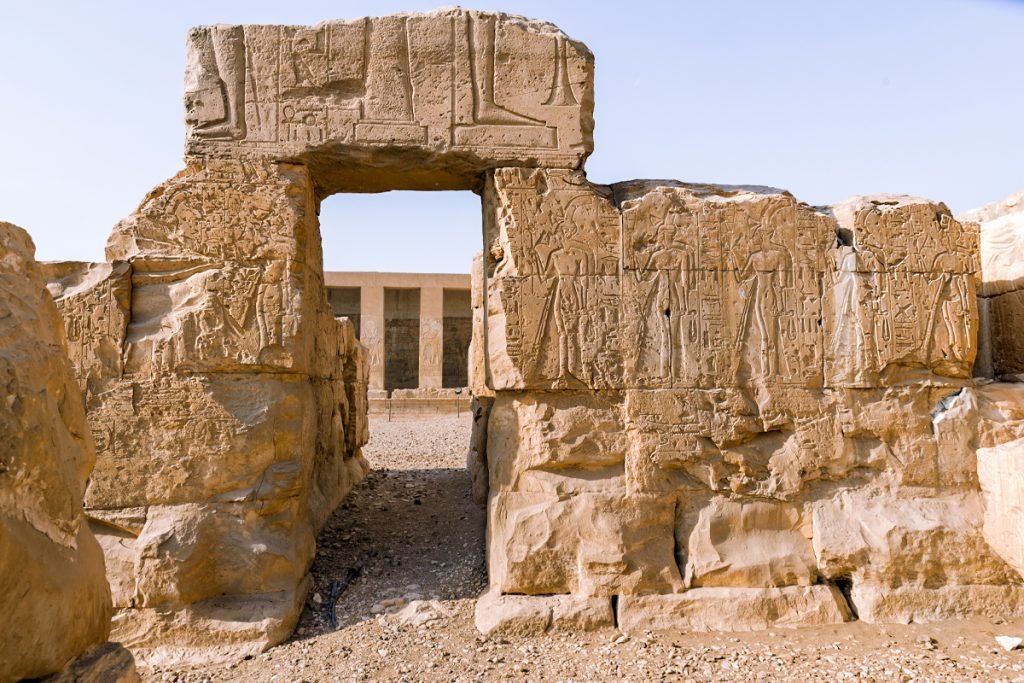
What are Abydos and the Osireion?
Abydos, in Upper Egypt between Luxor and Sohag, was one of the most sacred places of ancient Egypt. It was believed to be the burial place of Osiris, god of death and rebirth, and for centuries Egyptians made pilgrimages here or set up memorial stelae so they could share in his festival.
The main monument today is the Temple of Seti I, built in the 13th century BC and completed by his son Ramses II. Its painted reliefs are among the finest in Egypt, and its corridor holds the famous Abydos King List, a carved list of earlier pharaohs.
Behind the temple lies the Osireion: a sunken structure of massive granite pillars, built as a symbolic tomb of Osiris. It sits below today’s ground level and is often partly filled with groundwater, which gives it a striking, still atmosphere. Egyptologists generally link it to Seti I’s building works, although some alternative-history writers argue it is much older — a theory that is not accepted by mainstream archaeology.
Plan your visit: Amon Ra Tours arranges a private day trip to the temples of Abydos and Dendera from Luxor with a professional Egyptologist guide. Planning a group meditation journey? See our Egypt retreats page.
Why spiritual travelers are drawn to Abydos
For many visitors, Abydos feels very different from the busy sites of Luxor or Giza. It receives far fewer tour groups, the halls are cool and shaded, and the myth of Osiris — death, reassembly and rebirth — gives the place a natural theme for reflection.
Some travelers describe a special “energy” at the Osireion and in the inner chapels of the Seti temple. These experiences are personal and rooted in belief and spiritual tradition; they are not something science has measured. You don’t need to share any particular belief to enjoy Abydos: the silence, the light on the carved walls and the sense of history are reason enough to slow down here.
What is allowed inside the temple?
- Quiet personal meditation: sitting or standing silently in the halls is generally fine, as long as you don’t block walkways or other visitors.
- Do not touch or lean on the reliefs: the painted walls are fragile. Sit on the floor or on a small mat away from the walls.
- Chanting, sound bowls, group circles, candles or incense: these are not standard visitor activities. They need permission from the site authorities, which must be requested and confirmed in advance — never assume they will be allowed on the day.
- The Osireion: visitors normally view it from above. Access to the lower level is restricted and, where possible at all, depends on special permission and water levels.
- Photography and drones: rules and ticket requirements change, so check before you go; drones need official permits in Egypt.
How to visit Abydos
Most travelers visit Abydos on a day trip from Luxor, roughly three hours each way by road, and combine it with the Temple of Hathor at Dendera, which lies on the same route. Starting early lets you reach Abydos while it is quiet and cooler.
- Early morning: pickup from your Luxor hotel or Nile cruise.
- Abydos: guided visit of the Temple of Seti I, the King List and the view over the Osireion, with free time for quiet reflection.
- Dendera: the Temple of Hathor, with its astronomical ceiling and rooftop chapels.
- Evening: return to Luxor.
Opening hours, ticket prices and any road-travel arrangements should be confirmed shortly before your trip.
Tips for a meaningful visit
- Go in the cooler months (roughly October to April) and start early.
- Bring a light scarf or shawl; modest clothing is respectful and also protects from the sun.
- Ask your Egyptologist guide to explain the Osiris myth before you meditate — knowing the story makes the space more meaningful.
- Keep phones on silent and leave space for others who come to reflect.
- If you are bringing a group, share your plans early so timing and any permissions can be arranged.
Related guides
Continue your spiritual journey with our guides to the best places in Egypt for meditation and chakras and the sacred sites of Egypt. For a longer program, read how to organize a retreat in Egypt.
Curious about the symbols on the walls? Read the Flower of Life and the ankh at Abydos.
Frequently asked questions
Can you go inside the Osireion at Abydos?
Visitors usually see the Osireion from the viewing area above. Entering the lower level is restricted and requires special permission, which is not guaranteed and must be confirmed in advance.
Is meditation allowed in the Temple of Seti I?
Quiet personal meditation is generally fine as long as you respect other visitors and don’t touch the walls. Group rituals, chanting, candles or incense need advance permission from the site authorities.
How far is Abydos from Luxor?
Abydos is roughly three hours by road north of Luxor, so it is usually visited on a full-day trip, often combined with the Temple of Hathor at Dendera.
Why is the Osireion filled with water?
The Osireion lies below the modern ground level, close to the groundwater table, so it is often partly flooded. Water levels vary over time.
Can Amon Ra Tours arrange a meditation visit to Abydos?
Yes. Amon Ra Tours can arrange a private day trip to Abydos and Dendera with a professional Egyptologist guide and time for reflection. Any special access or group activity is requested in advance and depends on official approval.
🌟 Start Your Egyptian Adventure
Complete the form and let us create your perfect travel experience
Plan your trip with Amon Ra Tours
Private tours with a professional Egyptologist guide, hotel pickup and an air-conditioned vehicle. See our Luxor day tours and Luxor and Aswan Nile cruises, or tell us your dates and we will plan it for you.