


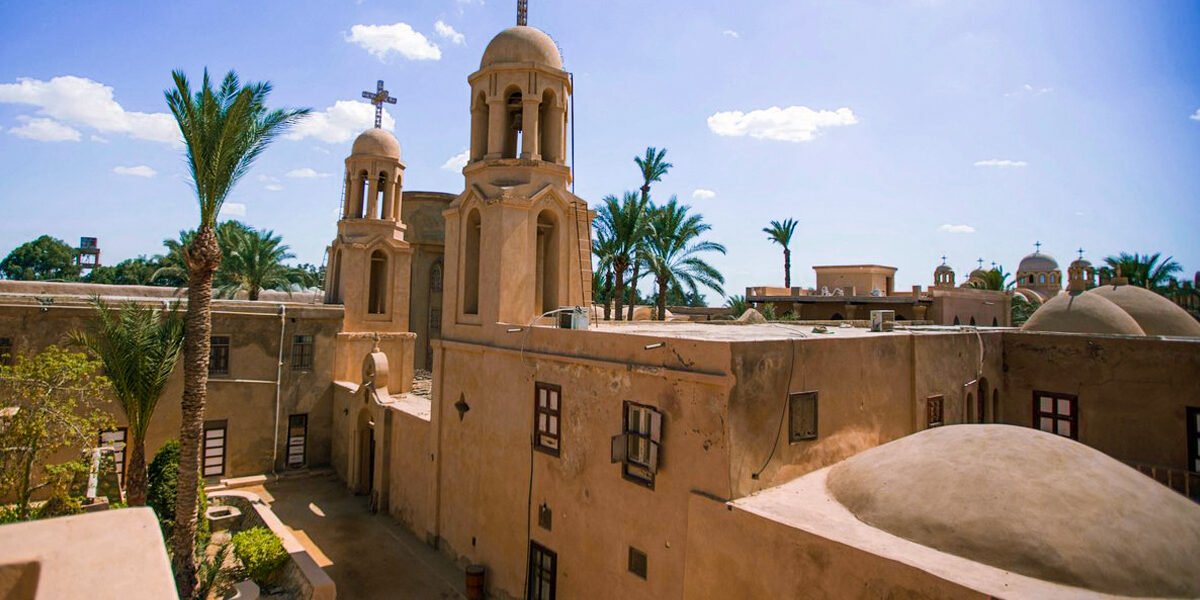
Quick answer: Wadi El Natrun is a desert valley about 100 km northwest of Cairo, on the desert road to Alexandria, and one of the birthplaces of Christian monasticism. Four ancient Coptic monasteries are still active there: Deir Anba Bishoy, Deir al-Suryan, Deir al-Baramus and Deir Abu Maqar. Coptic tradition also counts the valley as a stop on the Holy Family’s journey in Egypt, and it makes an easy day trip from Cairo.
Where is Wadi El Natrun?
Wadi El Natrun lies in the Western Desert, between Cairo and Alexandria, in a low depression that sits below sea level. Its name comes from natron, the natural salt collected from its lakes since ancient times. The ancient Egyptians used natron to dry and preserve bodies during mummification, so the valley was known long before the first monks arrived.
In early Christian writings the area is called Scetis, and from the 4th century it became one of the most famous monastic centres in the world. The sayings and stories of its monks, known as the Desert Fathers, were copied and read across the Christian world and shaped monastic life far beyond Egypt.
The Holy Family and Wadi El Natrun
According to Coptic tradition, the Holy Family crossed the western branch of the Nile and passed through Wadi El Natrun on their journey through Egypt, and the infant Jesus blessed the valley. For this reason it is one of the stations of the Holy Family route, which UNESCO recognised in 2022 when it inscribed the festivals related to the journey of the Holy Family in Egypt on its list of Intangible Cultural Heritage. You can follow the whole route in our guide to where Jesus lived in Egypt.
The four monasteries of Wadi El Natrun
Dozens of monasteries once stood in the valley. Four have survived through the centuries and are still home to communities of monks today.
Deir Anba Bishoy (Monastery of Saint Pishoy)
Named after Saint Pishoy, a 4th-century monk, this is the most visited monastery in the valley. Inside its walls are old churches, a keep (a defensive tower where monks took refuge during raids) and the relics of Saint Pishoy. Pope Shenouda III, the patriarch of the Coptic Orthodox Church from 1971 to 2012, is buried here, and many pilgrims come to visit his tomb.
Deir al-Suryan (Monastery of the Syrians)
Close to Anba Bishoy, Deir al-Suryan is dedicated to the Virgin Mary and takes its name from the Syrian monks who lived here in the Middle Ages. It is known for its medieval wall paintings and for the important manuscripts once kept in its library, many of which are now in libraries abroad.
Deir al-Baramus (Monastery of the Romans)
Deir al-Baramus, in the northwest of the valley, is often described as the oldest of the four. Its name is linked to two saints remembered in Coptic tradition as “the Romans”, Maximus and Domitius, who lived as monks in the valley.
Deir Abu Maqar (Monastery of Saint Macarius)
This monastery is linked to Saint Macarius the Great, the founder of monastic life in Scetis in the 4th century. Many patriarchs of the Coptic Church came from its community. It is the most secluded of the four, and visits may need to be arranged in advance.
Plan your visit: Wadi El Natrun is one of the stops on our 15-day Holy Family tour. In Cairo, you can visit the churches of Old Cairo on a private Coptic and Islamic Cairo tour, with a professional Egyptologist guide.
Visiting the monasteries: practical tips
- Getting there: the valley is about 100 km from Cairo, usually around one and a half to two hours by road, so a private car with a driver is the easiest way to visit. It can also be combined with a trip between Cairo and Alexandria.
- Opening days: visiting hours vary between monasteries, and visits may be limited during the main Coptic fasting periods, such as Lent before Easter. Check before you go.
- Dress code: wear modest clothing that covers your shoulders and knees, and remove your shoes where you are asked to in churches.
- Photography: rules differ from one monastery to another, and inside some churches photography is not allowed. Ask before you take photos, especially of monks.
- How long to stay: visiting two monasteries, usually Anba Bishoy and al-Suryan, which are close to each other, takes about half a day.
- Respect: these are working monasteries and places of prayer. Keep your voice low and follow the guidance of the monk or guide who shows you around.
Related guides
Explore the churches of Coptic Cairo, learn how Egypt celebrates Coptic Orthodox Easter, and discover why Egypt is called the land of the prophets.
Frequently asked questions
How far is Wadi El Natrun from Cairo?
About 100 km northwest of Cairo, on the Cairo–Alexandria desert road. The drive usually takes around one and a half to two hours.
How many monasteries are in Wadi El Natrun?
Four ancient monasteries are still active: Deir Anba Bishoy, Deir al-Suryan, Deir al-Baramus and Deir Abu Maqar.
Did the Holy Family visit Wadi El Natrun?
According to Coptic tradition, yes. The valley is one of the stations of the Holy Family’s journey in Egypt.
Can tourists visit the monasteries of Wadi El Natrun?
Yes. Visitors are welcome at the monasteries, especially Anba Bishoy and al-Suryan. Dress modestly and check visiting days, as visits may be limited during fasting periods.
Why is it called Wadi El Natrun?
The name comes from natron, the natural salt found in the valley’s lakes, which the ancient Egyptians used in mummification.
🌟 Start Your Egyptian Adventure
Complete the form and let us create your perfect travel experience
Plan your trip with Amon Ra Tours
Private tours with a professional Egyptologist guide, hotel pickup and an air-conditioned vehicle. See our Egypt holiday packages and Egypt day tours, or tell us your dates and we will plan it for you.