


Quick answer: Yes — a Flower of Life pattern (overlapping circles forming a six-petal design) is drawn on one of the granite pillars of the Osireion at Abydos. It is drawn on the stone rather than carved, and its age is uncertain: many researchers believe it was added much later than the Osireion itself. The ankh, by contrast, is a genuine ancient Egyptian symbol meaning “life,” and you can see it many times on the walls of the Temple of Seti I.
What is the Flower of Life at Abydos?
The Flower of Life is a geometric design made of evenly spaced, overlapping circles. At Abydos, two examples are drawn on a granite pillar inside the Osireion, the sunken structure behind the Temple of Seti I that was built as a symbolic tomb of the god Osiris.
The design became widely known in spiritual circles in the 1990s, especially through Drunvalo Melchizedek’s books The Ancient Secret of the Flower of Life, which presented it as a key to “sacred geometry.” Since then, many visitors come to Abydos specifically to see it.
It helps to separate what is known from what is believed. The pattern was not carved by the original builders in the way the temple reliefs were; it appears to have been drawn on the surface, possibly with red ochre. Egyptologists generally date it to a much later period — often suggested as Greco-Roman times or later — and similar designs are found in other ancient cultures. The idea that it encodes a lost ancient science is a belief held by some spiritual traditions, not an accepted archaeological finding.
Plan your visit: Amon Ra Tours arranges a private day trip to the temples of Abydos and Dendera from Luxor with a professional Egyptologist guide who can explain the symbols on the walls. Planning a group meditation journey? See our Egypt retreats page.
What does the ankh mean?
The ankh is the hieroglyph for “life.” It looks like a cross with a loop at the top, and it is one of the most common symbols in Egyptian art. Gods are often shown holding an ankh, or holding it up to the king’s face to give him the “breath of life.”
At Abydos, the Temple of Seti I is one of the best places in Egypt to see the ankh in context. Its painted reliefs are unusually well preserved, and offering scenes between Seti I and the gods — including Osiris, Isis and Horus — show the ankh again and again. In later centuries the symbol was adopted by Egyptian Christians as the crux ansata, and today many visitors wear it as a sign of life and continuity.
Why spiritual travelers are drawn to these symbols
For many visitors, Abydos is about rebirth: Osiris was believed to have died and been brought back to life here, and the ankh expresses that same idea of life renewed. Some travelers meditate on the Flower of Life as a symbol of unity and harmony, or feel a special energy at the Osireion.
These are personal experiences rooted in belief and spiritual practice, and they are respected as such; they are not something science has measured. Whether you come for the symbolism or simply for the history, the quiet halls of Abydos are a good place to slow down and reflect.
Can you see the Flower of Life when you visit?
- From the viewing area: visitors usually look down into the Osireion from above. The pattern is small and difficult to make out from there, so bring a camera with zoom or binoculars.
- Closer access: the lower level of the Osireion is restricted and often partly flooded. Any closer visit depends on special permission and water levels, and must be requested and confirmed in advance — it should never be assumed.
- Do not touch: neither the pattern nor the temple reliefs should be touched; the surfaces are fragile.
- Group rituals, chanting, candles or incense: these are not standard visitor activities and need advance permission from the site authorities.
How to visit Abydos
Abydos lies roughly three hours by road north of Luxor, so most travelers visit on a full-day trip combined with the Temple of Hathor at Dendera. A practical plan:
- Early morning: pickup from your Luxor hotel or Nile cruise.
- Abydos: guided visit of the Temple of Seti I, its ankh-filled offering scenes and the King List, then the view over the Osireion, with free time for quiet reflection.
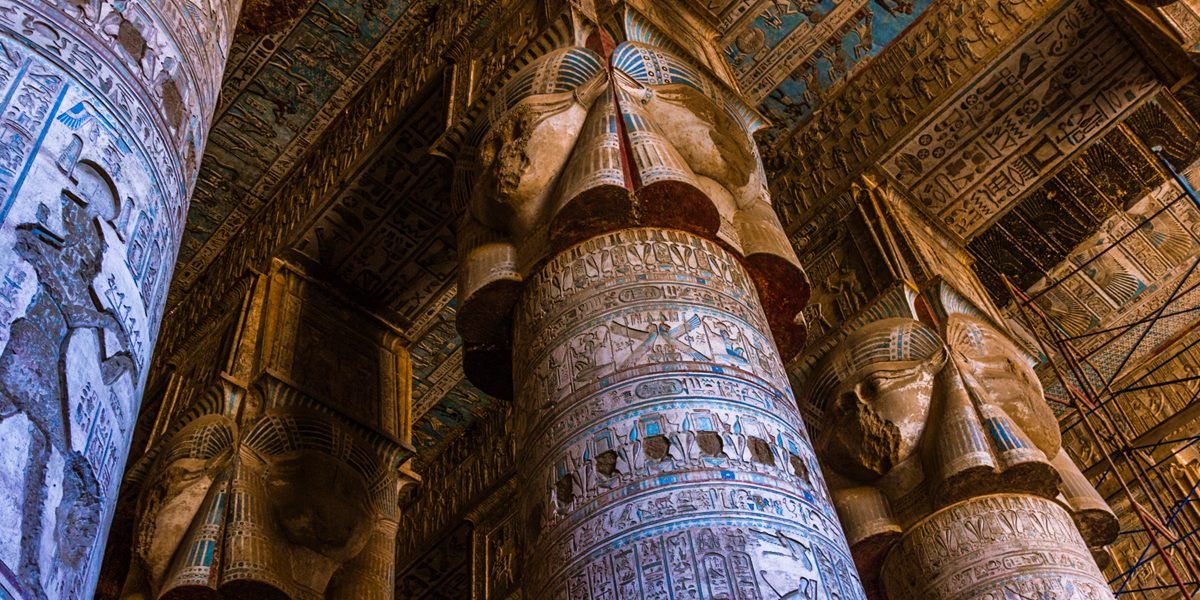
- Dendera: the Temple of Hathor, with its astronomical ceiling and rooftop chapels.
- Evening: return to Luxor.
Opening hours, ticket prices and road-travel arrangements should be confirmed shortly before your trip.
Related guides
Read our full guide to meditating at Abydos and the Osireion, and continue the story of the soul with the Ka and Ba in ancient Egyptian belief. Nearby, discover Dendera and the Temple of Hathor.
Frequently asked questions
Is the Flower of Life really at Abydos?
Yes. A Flower of Life pattern is drawn on one of the granite pillars of the Osireion, behind the Temple of Seti I. It is painted or drawn on the surface, not carved, and its date is uncertain; many researchers think it was added long after the Osireion was built.
Can you see the Flower of Life at Abydos?
Visitors normally view the Osireion from the viewing area above, and the pattern is small and hard to make out from there. Getting closer requires special access to the lower level, which is restricted and must be requested and confirmed in advance.
What does the ankh mean in ancient Egypt?
The ankh is the hieroglyphic sign for life. In temple reliefs, gods often hold it or offer it to the king, symbolising the gift of life and breath.
Where can you see the ankh at Abydos?
The ankh appears many times in the painted reliefs of the Temple of Seti I, especially in scenes where gods present it to the king. A professional Egyptologist guide can point out the clearest examples.
Can Amon Ra Tours arrange a visit to Abydos?
Yes. Amon Ra Tours arranges a private day trip to Abydos and Dendera from Luxor with a professional Egyptologist guide. Any special access to the Osireion depends on official approval and is requested in advance.
🌟 Start Your Egyptian Adventure
Complete the form and let us create your perfect travel experience
Plan your trip with Amon Ra Tours
Private tours with a professional Egyptologist guide, hotel pickup and an air-conditioned vehicle. See our Luxor day tours and Luxor and Aswan Nile cruises, or tell us your dates and we will plan it for you.