


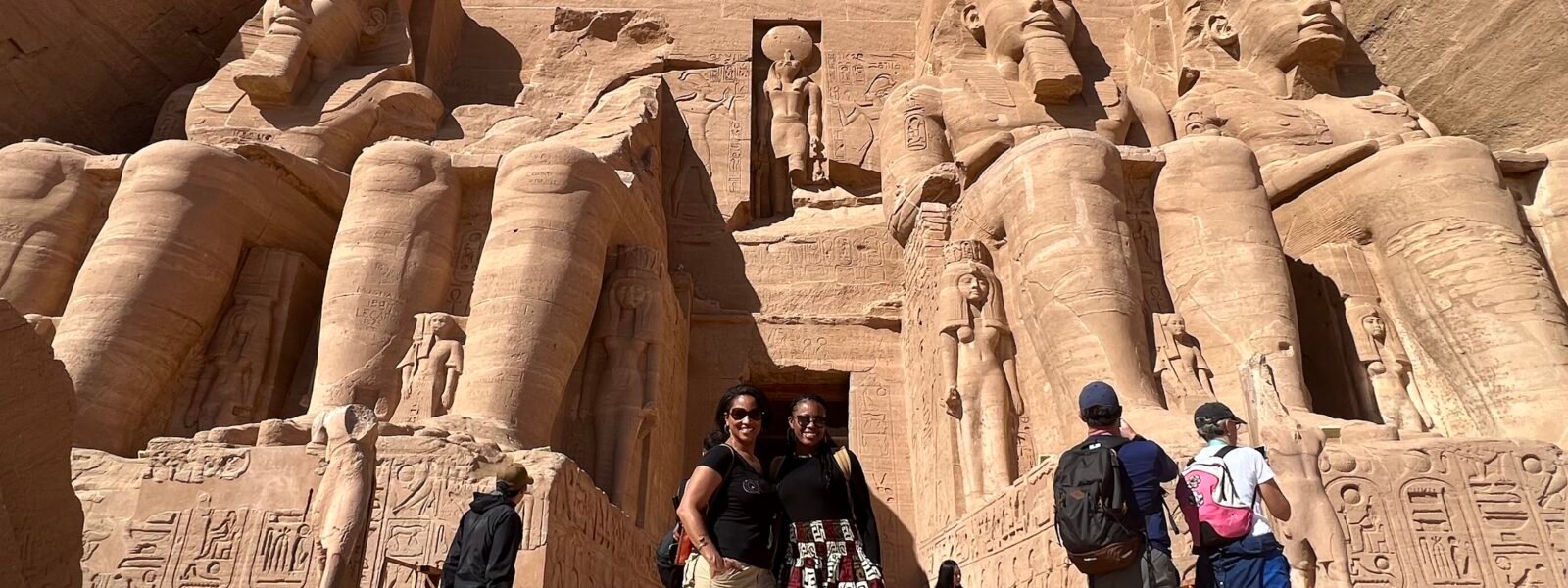
Quick answer: Several ancient Egyptian temples were built so that the sun lines up with them on special days. The most famous is Abu Simbel, where the rising sun reaches the inner sanctuary around 22 February and 22 October. At Karnak in Luxor, the sunrise on the winter solstice (around 21 December) lines up with the temple’s main axis. Both events draw large crowds, so planning ahead makes a real difference.
Why did the ancient Egyptians align temples with the sun?
The sun was at the centre of Egyptian religion. Ra, the sun god, was believed to sail across the sky by day and through the underworld by night, and the king was his son on earth. Building a temple so that the sun’s light touched its holiest room at a key moment of the year was a way of showing that the gods, the king and the cosmos were in harmony.
Temple builders could observe the horizon with great care, and the cycles of the sun also helped them keep the calendar. Some alignments are clearly intentional; others are still debated by archaeologists and astronomers. It is worth keeping that in mind, because many modern claims about Egyptian “solar codes” go well beyond the evidence.
Abu Simbel: the Sun Festival
The Great Temple of Ramesses II at Abu Simbel, south of Aswan, is the clearest example. Twice a year, around 22 February and 22 October, the first rays of the rising sun travel deep into the temple and light up the statues in the inner sanctuary. Three of the four seated figures, Ra-Horakhty, Amun-Ra and the deified Ramesses II, are lit, while Ptah, a god linked with the underworld, stays in shadow. The effect lasts around twenty minutes.
The dates are often linked to Ramesses II’s birthday and coronation, but there is no ancient text that confirms this. When the temple was cut into blocks and moved to higher ground in the 1960s to save it from Lake Nasser, the alignment was kept, although the dates shifted by about a day.
Plan your visit: Amon Ra Tours arranges a day trip to Abu Simbel from Aswan, and a private Luxor East Bank tour of Karnak and Luxor Temples, both with a professional Egyptologist guide. For festival dates, ask us early: transport and tickets are in high demand.
Karnak: the winter solstice sunrise
Karnak Temple in Luxor was the great home of Amun-Ra. Its main east–west axis points towards the place where the sun rises on the winter solstice. Around 21 December, visitors standing inside the temple can watch the sun come up along this axis, framed by the ancient gateways. In recent years, hundreds of visitors and local residents have gathered at Karnak to watch it.
The moment is quieter and shorter than the Abu Simbel festival, but seeing the first light of the shortest day pass through a temple built more than three thousand years ago is unforgettable, especially combined with a full day exploring the East and West Banks of Luxor.
The Sphinx and the equinox sunset
At Giza, many photographers wait for the spring and autumn equinoxes (around 20 March and 22 September). Seen from the area near the Great Sphinx, the sun sets close to the side of the Pyramid of Khafre. Whether this was planned by the builders is debated, but it makes one of the most striking views on the plateau. Viewing positions depend on site rules and opening hours, so check them for the day you plan to go.
The total solar eclipse of 2 August 2027
Egypt will also see a rare natural event: a total solar eclipse on 2 August 2027, with Luxor close to the centre of its path and more than six minutes of totality. Luxor’s temples will be one of the most memorable places on earth to watch the sky go dark. See our Egypt solar eclipse tour with a Nile cruise, and book early, as hotels and cruises are expected to fill well in advance.
Tips for watching a solar alignment
- Arrive before dawn. For Abu Simbel, this usually means leaving Aswan in the middle of the night by road, or taking an early flight. Queues start long before sunrise.
- Expect crowds. Festival days at Abu Simbel draw thousands of people. Inside the temple, visitors move through in turns, so the view of the sanctuary can be brief.
- Check dates and hours close to the time. Exact days, opening times and any special arrangements are announced by the authorities and can change.
- Consider a quieter day. If you dislike crowds, visit Abu Simbel or Karnak on a normal day. The temples are just as impressive, and a professional Egyptologist guide can explain how the alignment works.
- Never look directly at the sun. For the 2027 eclipse, certified eclipse glasses are essential except during the short period of totality.
Related guides
Discover how the sun shaped ancient Egyptian belief in our guide to sunrise meditation at the Pyramids and Sphinx, learn about Amun-Ra, the king of the gods, and see how temples were designed for the soul in the Ka and Ba. Planning a group journey? See our Egypt retreats page.
Frequently asked questions
When is the Abu Simbel Sun Festival?
The sun reaches the inner sanctuary of the Great Temple of Abu Simbel around 22 February and 22 October each year, shortly after sunrise. The exact timing should be checked close to your trip.
What happens at Karnak on the winter solstice?
Around 21 December, the sun rises in line with the main east–west axis of Karnak Temple in Luxor, so visitors inside can watch the sunrise framed by the temple’s gateways.
Which statue stays in the dark at Abu Simbel?
Ptah, a god linked with the underworld, stays in shadow, while the statues of Ra-Horakhty, Amun-Ra and Ramesses II are lit by the rising sun.
Can I visit Abu Simbel for the Sun Festival from Aswan?
Yes. Most visitors travel from Aswan by road before dawn or take an early flight. Because demand is very high on festival days, transport and tickets should be arranged well in advance.
When is the solar eclipse in Egypt?
A total solar eclipse will cross southern Egypt on 2 August 2027. Luxor is close to the centre of the path, with more than six minutes of totality.
Private tours you might like
🌟 Start Your Egyptian Adventure
Complete the form and let us create your perfect travel experience
Plan your trip with Amon Ra Tours
Private tours with a professional Egyptologist guide, hotel pickup and an air-conditioned vehicle. See our Luxor day tours and Luxor and Aswan Nile cruises, or tell us your dates and we will plan it for you.